Showing posts with label Mountains. Show all posts

Wednesday, September 5, 2018

SHIMLA IN THE RAINS - II

HERITAGE AND NOSTALGIA

JAKHU HILL

Sitting at ‘Under Tree’, atop Jakhu Hill, I watch the thick mist roll over the deodar forest as I sup on steaming soup. At more than 8000 ft, this is the highest peak in Shimla. The rain adds an ethereal element to the atmospherics and it feels like I am floating on clouds. Troops of macaques and langurs are roaming freely; we are the ones caged in our glass-house cafe. It’s an apt reminder that the monkeys are the earliest denizens of Shimla from the time when the hills, “…(some of which) have remained untrodden since creation", as Emily Eden, sister of Governor General Lord Auckland documented. Long before the British arrived, there was a shrine to Lord Hanuman on “Mount Jakko”, the original location of Old “Shyamala” village from where the hill-station, arguably, gets its name. The Hanuman temple that stands here today must have gone through several avataars over this period.   

In 2010, a 108-feet tall idol was erected in the temple premises which, more often than not, stays cloaked in mist and is a big draw with the tourists. We have a special affinity to Hanuman as he is my husband’s family (village) deity from where the family gets its name. Here, the errant macaques have right of way. If you are not careful, they will run away with your footwear or some other accoutrement. The trick is to offer a packet of chana and bribe the culprits into returning the stolen items. One old man had to bid goodbye to his glasses. He followed the drill but even as he offered the customary chana, he hastened to snatch the glasses. Displeased, the rogue ran away with both!

 OLD SHIMLA  SUMMER HILL 

Hill-stations are charged with nostalgia. The history of a place comes alive, primarily, in its heritage buildings and museums. Shimla was the summer capital of India during the imperial era. The British took residency here leaving behind a legacy of colonial houses, but a lot of wealthy Indians settled here, too. Rajkumari Amrit Kaur was one such prominent personality who had an abode in Summer Hill, called Manorville Mansion.  Descendant of Maharaja of Kapurthala, she served as one of Gandhiji’s private secretaries for more than a decade and was in the forefront of the freedom movement. She had the distinction of being the first woman Cabinet Minister (Health) of independent India. The All India Institute of Medical Sciences was her initiative.

It took us a while to locate the bungalow, but there it was - Rajkumari Amrit Kaur Bhavan - in the heart of Himachal Pradesh University Campus, a guesthouse for AIIMS personnel. Painted in signature red and white as other heritage houses in Shimla, this colonial bungalow sits amidst conifer forests overlooked by Summer Hill. We had come to see the house out of curiosity, but hit upon a minefield.

The Bhavan is a memorial to Mahatma Gandhi who stayed here, off and on, over several years when he visited Shimla on political sojourns. Two rooms are dedicated in his memory−his workplace with a desk and a modest bedroom where he would retire. Memorabilia such as crockery and archival photographs of political events brought the era alive. With a little bit of imagination, I was transported to moments in history; Gandhiji having discussions with Nehru and Patel or waving out, from the balcony, to the people who had gathered outside. Interestingly, Manorville with its mossy walls and wildflower proved a pitstop for my penchant for macro photography.


SUMMER HILL RAILWAY STATION

A friend suggested a visit to the quaint Summer Hill Railway Station to fulfil my photography cravings. The station on the narrow-gauge Kalka-Shimla line is a relic from the past. Standing on the bridge looking down at the platform, I felt it wasn’t half as enchanting as Coonoor railway station in the Nilgiris

To get away from the drizzle, we scampered to the platform for shelter. As we were strolling around, a young “gentleman”−all suited up with a fedora hat to boot−approached us. For a moment, it seemed like we had stepped into a time machine. In clipped, albeit desi-accented English, he wanted to know what we were looking for. He seemed wary of our intrusion, but soon Sushil Kumar, the station-master, warmed up to us. He was all praise for the British and their legacy of railways which he thought “we corrupt Indians are not worthy of”.

As though to testify, he welcomed us to his cabin that was virtually a recreation of the bygone era. Unfortunately for me, photography was not permitted inside. He demonstrated how the old-world signalling system and telephone line was operated. Once the green signal was confirmed and locked for an oncoming train, a token was generated. He demonstrated how the token was put in a ring for the pointsman to hand it over to the incoming locomotive’s driver. It was a failsafe method, “visionary” of the British, he maintained. Every time the phone rang, the “brown sahib” rose up to his full stature, in a manner of speaking, and greeted: “Summer Hillla…” in an unmistakable Punjabi twang, letting his guard slip.

MARIA BROTHERS

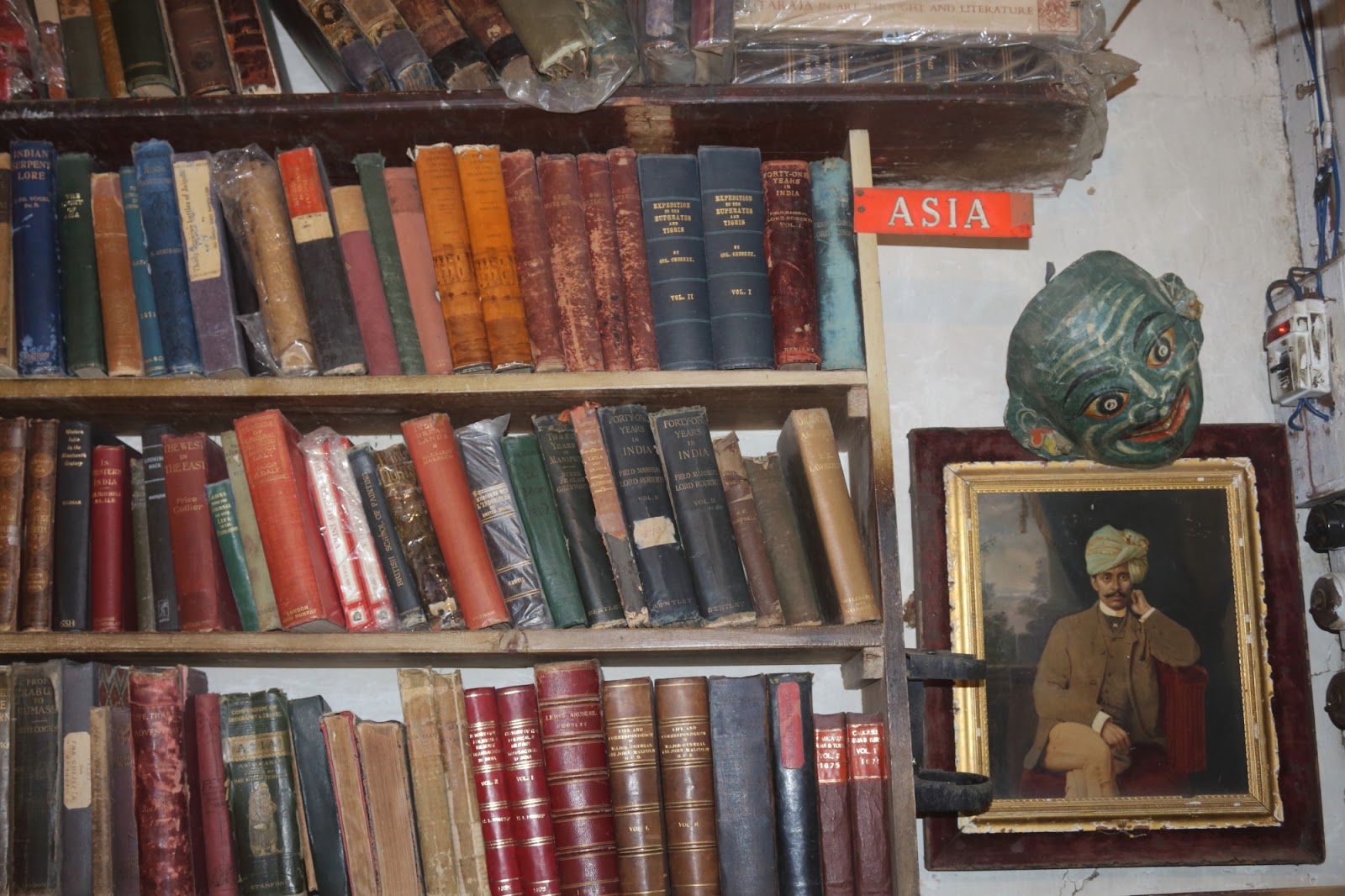
While lot changes in hill-stations in the name of tourism, lot remains the same. Settlers and residents are loath to change their old way of life. Therefore, over a period of time, some shops and businesses become institutions riding on their reputation and word-of-mouth publicity. Maria Brothers is one such iconic presence. A hole-in-the-wall bookshop on the Mall Road, it specialises in rare and antiquarian books. I remember visiting it many moons ago and coming away mesmerised with its collection. I was eager to see how it fared two decades hence.

The shop is in disarray with worn out books (some even termite-ridden) shoddily stacked on shelves. Books are literally going to dust even as the prices are going through the roof. The titles though are a million bucks. There are some antiques and lithographs covered in layers of dust. Prints of Amrita Shergill’s work catch my eye. The artist had stayed in Shimla for a while and painted the poor ‘Pahari’ (hill) people for whom she developed great compassion.  For salaried customers like us, the prints are sorely out of reach.

Rajiv Sood, one of the brothers and co-owners, is manning the shop. With a scraggly stubble and thick glasses, he looks old and beaten. There is an air of aloofness about him or to be charitable, perhaps he was having a bad day. I overhear him talk on the phone about his eyes troubling him. I push past his reticence and ask if tourists visit his shop like before. “No one reads books anymore,” he rues. Book collectors too are fading away. Time was when he used to source books from across the globe; not anymore.

The shop is resting on its laurels and not keeping up with changing times. The owner needs to do some serious stock-taking. The prices need to be reduced and the books put up for sale or auction before the termites consume them. Books that can be salvaged need to be refurbished, others that are far gone should be dumped. It would be a colossal waste to let the treasures come to a naught. It’s not doing great for the shop’s reputation and credibility, either.  


MINOCHA BROTHERS

Another such institution is Minchy’s at Lower Bazaar. The market is a maze of winding roads with old rickety buildings sticking out haphazardly. The tangle of wires overhead adds to the cluttered feel of the busy street down below. We are here to pick up pickles and preserves made from local products. Minchy’s is not your swank shop with gleaming glass top and counters. It is part of the nondescript Minocha Ghee store, the humble beginning from which Minchy’s grew. Colourful bottles and jars with “Minchy’s” branded on them assure us we are at the right place. An old gentleman welcomes us heartily; Mr. Minocha, the owner, is happy to know we belong to the naval fraternity.

We are treated to litchi juice which tastes like fresh fruit. Mr. Minocha carries on his sales spiel even as he regales us with his life-story. He came to Shimla from Lahore nearly 45 years ago when the hills were a different place altogether. He talks fondly about his daughter and daughter-in-law. The daughter-in-law, Sonia, is enterprising and makes pickles at home that are sold under her name. Minchy’s speciality is the Lungru pickle made from fiddlehead fern. He extols the virtues of their wines made from plum, peach, apricot, apple, and rhododendron in the same breath as declaring his distaste for Goan feni. He is truly happy to talk to us and says so time and again. Perhaps, the fact that we are chatting with him with no hurried agenda, unlike other tourists, makes him feel special.

As we step out of the shop laden with foodie-goodies, my gaze turns upward. Rising above the chaotic hill town, Lord Hanuman appears out of the clouds, like a chimera. It is a moment of epiphany. Shimla’s guardian angel is looking over it.

-------------------------------------------------------------------------------------------------------


-------------------------------------------------------------------------------


ALSO READ: Shimla in the Rains - I  - ("Olive" Green) 

More Wildflowers at: https://padmaja-earthletters.blogspot.com/2018/09/niche-flora-in-shimla.html


ALL PHOTOGRAPHS IN THIS BLOG AND WEBSITE ARE THE AUTHOR'S ORIGINAL WORK/COPYRIGHT


Friday, June 20, 2014

Slow Dance of The Elephants

The Aberdare Experience

Aberdare Ark is a modern-day machaan, except that it is a building (shaped in an ark) with all amenities afforded to tourists for a comfortable stay! It sits next to a natural salt lick in a clearing within the lush Aberdare tropical forests of Kenya. The Ark has a viewing gallery in the basement where one is level with the waterhole, a terrace which gives one an overhead view and a mezzanine lookout which is barely clear of the tallest elephant’s height!

When we reached the Ark it was approaching sunset, a perfect time for animals to congregate at the waterhole before they called it a day. An elephant parade was lined up, with some African cape buffaloes blending in, almost as though to welcome us. In the awed hush all we could hear was the odd rumble and rustle, an overwhelming assertion of life! Unlike other safaris where we encountered elephant herds browsing and feeding from time to time and took pretty pictures, the Aberdare experience was one to watch elephant behaviour and bonding, intimately, in their natural habitat.

From the terrace, I spotted a cow with a calf huddled by its side; other young ones came to caress and pet it, all the time ensuring that it was well-flanked and protected. Two juveniles from different clans came upon each other, touched and twined their trunks, and indulged in boisterous play for a while. One of the young adults had something hanging loose at the end of its trunk; it took me a while to figure that the trunk itself was mutilated and a part of it was hanging by a lip! It seemed like an old wound and the mammal was able to adapt it beautifully despite the deformity.


Elephant herds of varying strength were trooping in and out of the thicket to the waterhole. One of the young male was wounded with blood oozing from its face. You could see, it was desperately seeking attention and commiseration from others, like a little child. It would go close and try to touch every other elephant that came out of the bush. I was shocked to see that it was being shunned by one and all! To my mind it seemed like a case of adults chiding, “I told you so”, for “not listening” to sane counsel! Or maybe there was some other explanation that we have no way of knowing.

As the day wound to a close, I shifted my observation post to the open balcony by the path where the animals had to retreat into the thick vegetation. There was an embankment of boulders - two feet wide - below the balcony to keep the elephants from straying too close. Every time an elephant approached my side and passed by, it would, unfailingly, lift up its trunk sniffing my presence. But their reactions were different. Some were wary, some baulked and some actually bolted, timidly, tail in the air. I wondered how much of my olfactory signature was imprinted on their memories and if I were to encounter them out in the wild would they recognise me!


The jumbos had called it a day and all the resident tourists too retreated to their cubby-hole cabins for a doze. Being claustrophobic, I had to wait out the night somehow. Somewhere around 2 or 3 at night, I must have drowsed only to be awakened by a sixth sense. I went to the balcony to gulp in fresh air just in time to see a faint trickle of pearly grey masses coming out into the open. In the still moonlit night, for the next hour and a half, a slow dance-drama unfolded - for my eyes only - leaving me completely dazed.

A matriarch with a calf, few females and some sub-adults began confabulating by the pool. Soon the calf lay at its mother’s feet to rest and three-four grown-ups stood in a semi-circle forming a protective cover. 

The mater moved away closer to the water’s edge, sniffed the wind, and kneeled down as though checking the depth of the pool with its probing trunk. It tore away the grass growing at the edges and gobbled it. Soon it had rolled onto its side, raised its trunk, and was contorting its body! My first impression was that this animal was sick; that it might have a tummy problem. For an instant it almost seemed like it was in throes. I hadn’t seen anything so bizarre all my life! The matriarch wallowed and writhed as the herd watched respectfully from a distance, not breaking her trance.

She then strode back to its family by when the calf was up and rejuvenated. Then a slow, deliberate, rhythmic ritual ensued… trunks entangling, twining, and feeling each other. The entire herd stood still in a wedge formation with its trunks touching. After a long while, the formation turned inside out with the bottoms now jostled together. Was it a family get-together where they were narrating stories and anecdotes, trading notes and even, joking?

The calf and the sub-adult were left out of the loop, surprisingly, left unprotected behind their backs! When the calf attempted to pry from behind, curious, the matriarch without so much as a look gave it the boot sending it scurrying out of the charmed circle! With no perceived threats and comfortable in the privacy of their circle, they could now afford to keep the pesky young ones out of their adult “bedroom” conversation!

The herd stood in varied patterns and formations (interminably, it seemed!) and changed positions at intervals. If that one hour could be filmed, fast forwarded and reduced to a 15- 20-minute clip, then I would be witness to a rhythmic gyration, a slow ballet.

Was it a spiritual ceremony or a cult ritual? Or I wondered if the herd was mourning having heard and read so much about elephant’s graveyards and death rituals.

Benson, the in-house naturalist, discounted it saying that in the 40 years of the lodge’s existence no elephant had died or was buried there. He had this to say: “Elephants are highly evolved social creatures and with a lot of research being done on their memory and behaviour, scientists haven’t finished yet. I would think we haven’t begun yet.” 


ALL PHOTOGRAPHS IN THIS BLOG/ BLOGSPOT ARE THE AUTHOR'S ORIGINAL WORK/ COPYRIGHT

Saturday, January 24, 2009

A Tale of Two Towns


Explorer Johann Ludwig Krapf first documented the presence of Mt. Kenya (in East Africa) straddling the Equator: “…two large horns or pillars rising over an enormous mountain to the north west of Kilimanjaro, covered with a white substance.”  There was disbelief then to the point of heaping ridicule on the explorers that snow and equator could co-exist geographically. This was in 1849. For the Wakamba people at its foot, though, this “discovery” was a foregone reality.  Something similar happened in 1859 when explorer Richard Burton who set his eyes on the Blue Mountain range in South India commented: “Such a climate within the tropics was considered so great an anomaly that few could believe its existence.” He was spying the range of Neilgherry that had already been “introduced” and “authenticated” in 1819 by John Sullivan, then Collector of Coimbatore, as a “discovery” to the world at large, no matter it was home to Toda tribe for centuries. But that is digressing.

Kodanad Nilgiris
Mt. Kenya 


Can two places, continents apart - one to the north of equator and the other just south of it, have any common ground? Probably not, one is forgiven for presuming. But if I said that not only can two places have commonalities but bear uncanny similarities, wouldn’t it sound incredulous? Central Highlands in Kenya and Blue Mountains in India, both places where I spent three unforgettable years of my life, count up to the idea.  Nairobi town, just one degree south of equator in the continent of Africa, answers perfectly to the clichéd phrase, “salubrious climes”, that describes Wellington (or Coonoor and Ooty, for that matter) in Nilgiris best. And that is where the analogies just about begin.

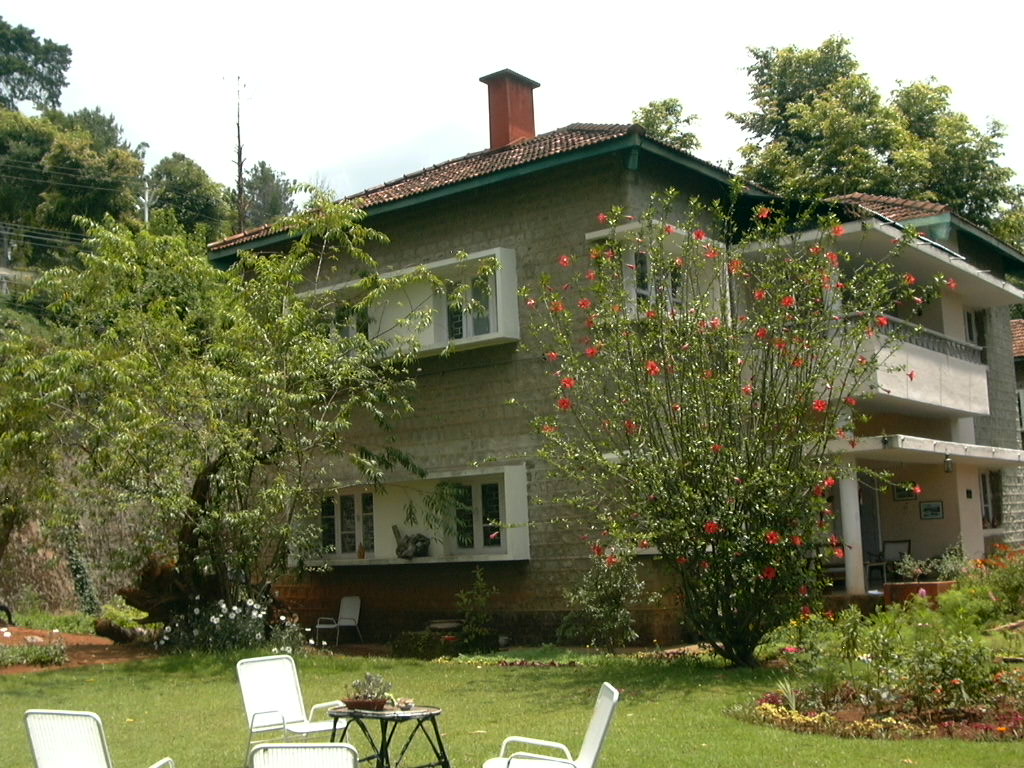
Cut to the 21st century. Dandy dahlias, crisp white chrysanthemums, cannas and purple-burst agapanthus or African lily border the well-trimmed lawns, the lines of which are broken intermittently by frangipani and bougainvillea bushes. The peach tree is laden with fruits and so is the guava. Kites trill and encircle the garden as the sparrows pick at the bird feeder. Across the boundary wall, in a glen, masses of pine and eucalyptus jostle with the cypresses and the cool breeze intoxicates the senses. Sitting on the patio of my duplex I am taking in the scenes of the day. For a minute, I lose my bearings and think I am in Gulistan of Wellington Cantonment, but that is not the case. This is the DAK (Defence Adviser, Kenya) Bungla (as I like to call it) in Nairobi where we are currently situated. If photographs of the two houses, with the gardens, were to be juxtaposed as in a child’s puzzle of Spot the Difference, it would be hard to tell them apart.

The bird wealth of Nairobi too rivals that of Wellington-Coonoor. If Nilgiris has its endemic and eponymous thrush, Nairobi has the African Olive Thrush whose fluting call can bridge time and space. I could be walking along the pine forests of Wellington Gymkhana Club while actually I am at the Windsor Club in Nairobi’s kosher locality on a birdwatching trail. Like Nilgiris, Central Highlands is a land of tea, thrushes and tribes.


Tea garden Nilgiris
Maramba Tea Estate Tigoni Nairobi
It feels like yesterday it was with a heavy heart that I left Wellington (but actually ten months back). In the two plus years that I was in Wellington, I felt as though I belonged there like nowhere else. Funny how, after years of living in an urban climate, you come to a strange unknown place and feel that you have come home. The open landscape of the blue mountain range with the ubiquitous eucalyptus and the song of the Malabar whistling thrush have made home in my mind permanently. So you can imagine how heart wrenching it must have been to leave the place when it was time. But who could have imagined that a place, oceans apart, could resonate with a similar rhythm – where places and people, at every instance, bring back memories from the Wellington–past as in a motion picture flashback?

Take the Mboga experience, for instance (Mboga means vegetables in KiSwahili, the national language of Kenya). In the heart of the city, by the arterial road with its zipping cars, lies the Mboga market which stocks all manners of vegetables – from cucumber and carrots to greens and gourds. Luscious apples and midget paw paws beckon from any number of ramshackle stalls. Here, you can shop for the apple mangoes (which are mangoes and not apples) all the year round and golden apples (which are apples though not golden) that look like green apples from outside but are mushy like custard apples inside. The sheer variety and quality of the vegetables and fruits leaves one gasping. Few misinformed travelers and friends had given us to understand that we may have to give up vegetarianism to partake of bush meat, the staple of the locals. They couldn’t have been farther from truth.

This wholesale market is a microcosm of Kenya’s mwananchi (public), but if you simply blot out the people, you could be standing in Coonoor’s sabzi mandi where we used to go for our weekly fix. Come to think of it, even the skin colour of the vegetable mama or bwana is not much different from the dark-skinned Tamilians down South India! Across the oceans and continents as worlds change it is funny how some things still remain the same. My visit to the Mboga market often ends with relishing the butta or corn-on-the-cob roasted on slow charcoal fire on a makeshift grill. In typically desi style, this is spiced with salt-chili combo daubed by means of lemon wedges. It is complete enigma how two countries globe apart come to share such culinary fare and practices. Roadside eateries - not of Indian origin but of local flavor, mind you - announcing staple of chai, chapatti and even samosas make you wonder if you ever left the Indian shores.

One of the obvious reasons for these similarities is the “legacy” of the British that bonds India and Kenya as both have been British colonies. Just as the British eliminated natural forests in Nilgiris or Assam, the landscape in Kenya too was transformed to pave way for tea plantations, and therefore, the chai. Nairobi, at an altitude of 5500 ft like Coonoor, has a climate congenial to tea and tea plantations veiled in mist greet you on the outskirts of Nairobi, in Tigoni and Limuru. The picture postcard images of camellia bushes on rolling hillsides can be interchanged without anything being amiss. Is it Coonoor or Nairobi - who can tell?

Towards the end of the nineteenth century, Indian indentured labour was sought to build the Uganda Railway to connect the Kenyan coast of Mombasa to Lake Victoria in Uganda. This set into motion the second wave of Indian diaspora which became a torrent subsequently. But even before that, way back in the first century, traders from Kutch in Gujarat – intrepid and unsung explorers in their own way – left home shore to seek fortune in a strange land. The Indian merchants came in dhows ‘harnessing trade winds’, as it were, to encash on the vibrant trade in the Indian Ocean countries and settled in with their dukas (KiSwahili for shops. A lot of Hindi words find place in Kiswahili - yet another instance of consonance among the two countries). Like the ubiquitous China towns over the world, there is an India town in the heart of the city which gives us a sense of home away from home. The shopping complex of Diamond Plaza is the hub of Indian culture and cuisine. From idli-dosai joints to chaat corners and kirana stores to mithaai dukas, India is available on a platter here. Indians may have fanned out across the globe but the Indian connection in Kenya is unique. For instance, Nairobi city was built around an Indian township to begin with. Today, Nairobi boasts of nearly a lakh Indians, many of them third and fourth generation descendants who have altered the demographic and cultural landscape of Nairobi.

The Uganda Railway was aimed to cut across the hinterland of Africa but was actually a lifeline through the heartland of Kenya. The Blue Mountain Railway (now Nilgiri Mountain Railway), on the other hand, the history of whose construction is alien to me, was built to enable access from the plains of Coimbatore to the hills of Ootacamund. The journey I made on this meter gauge line in a toy train from Wellington to Ooty was unlike any experience I have ever had. The misty vistas of hills and dales, the unending tea gardens dotted with silver oak, sleepy hamlets amidst winding streams, and the biting inviting cold will haunt me forever.

Coming back to my Wellington home of Gulistan, I indulged in gardening and planted many seasonals such as dahlias and gazanias, but water scarcity and absence of a steady gardener stymied my ambitions of nurturing it to perfection. Great gardening ideas of breathing life into begonias and carnations were put on the backburner as the aforesaid constraints nixed its viability. And towards the end, I even had to contend with the misfortune of the gardener leaving and the garden falling into disarray and decay as we got busy with packing and moving.

In Nairobi, I have a dedicated gardener, and the soil is incredibly fertile such that one can see seedlings and saplings grow tall by inches overnight. I have planted sunflowers and hollyhocks with a vengeance and am tending a vegetable patch in the backyard. In less than a month, the modest harvest of kale, carrots, lettuce, eggplants, tomatoes and radish has been meeting a quarter of my weekly needs. I seem to have simply taken off from where I had left in the past.

The chasm that Wellington left in my heart will never be filled, but it has been bridged somewhat by the magic of its soul city, Nairobi. The Kenyan Highlands have replaced the Blue Mountains of my desire, for the time being.


Lily of Peru (Alstroemeria) in Gulistan, Wellington
Lily of Peru in DAK Bungla, Nairobi


Nairobi
Wellington


Gulistan Wellington Nilgiris


DAK Bungla Nairobi Kenya