Showing posts with label Travel. Show all posts

Wednesday, September 5, 2018

SHIMLA IN THE RAINS - II

HERITAGE AND NOSTALGIA

JAKHU HILL

Sitting at ‘Under Tree’, atop Jakhu Hill, I watch the thick mist roll over the deodar forest as I sup on steaming soup. At more than 8000 ft, this is the highest peak in Shimla. The rain adds an ethereal element to the atmospherics and it feels like I am floating on clouds. Troops of macaques and langurs are roaming freely; we are the ones caged in our glass-house cafe. It’s an apt reminder that the monkeys are the earliest denizens of Shimla from the time when the hills, “…(some of which) have remained untrodden since creation", as Emily Eden, sister of Governor General Lord Auckland documented. Long before the British arrived, there was a shrine to Lord Hanuman on “Mount Jakko”, the original location of Old “Shyamala” village from where the hill-station, arguably, gets its name. The Hanuman temple that stands here today must have gone through several avataars over this period.   

In 2010, a 108-feet tall idol was erected in the temple premises which, more often than not, stays cloaked in mist and is a big draw with the tourists. We have a special affinity to Hanuman as he is my husband’s family (village) deity from where the family gets its name. Here, the errant macaques have right of way. If you are not careful, they will run away with your footwear or some other accoutrement. The trick is to offer a packet of chana and bribe the culprits into returning the stolen items. One old man had to bid goodbye to his glasses. He followed the drill but even as he offered the customary chana, he hastened to snatch the glasses. Displeased, the rogue ran away with both!

 OLD SHIMLA  SUMMER HILL 

Hill-stations are charged with nostalgia. The history of a place comes alive, primarily, in its heritage buildings and museums. Shimla was the summer capital of India during the imperial era. The British took residency here leaving behind a legacy of colonial houses, but a lot of wealthy Indians settled here, too. Rajkumari Amrit Kaur was one such prominent personality who had an abode in Summer Hill, called Manorville Mansion.  Descendant of Maharaja of Kapurthala, she served as one of Gandhiji’s private secretaries for more than a decade and was in the forefront of the freedom movement. She had the distinction of being the first woman Cabinet Minister (Health) of independent India. The All India Institute of Medical Sciences was her initiative.

It took us a while to locate the bungalow, but there it was - Rajkumari Amrit Kaur Bhavan - in the heart of Himachal Pradesh University Campus, a guesthouse for AIIMS personnel. Painted in signature red and white as other heritage houses in Shimla, this colonial bungalow sits amidst conifer forests overlooked by Summer Hill. We had come to see the house out of curiosity, but hit upon a minefield.

The Bhavan is a memorial to Mahatma Gandhi who stayed here, off and on, over several years when he visited Shimla on political sojourns. Two rooms are dedicated in his memory−his workplace with a desk and a modest bedroom where he would retire. Memorabilia such as crockery and archival photographs of political events brought the era alive. With a little bit of imagination, I was transported to moments in history; Gandhiji having discussions with Nehru and Patel or waving out, from the balcony, to the people who had gathered outside. Interestingly, Manorville with its mossy walls and wildflower proved a pitstop for my penchant for macro photography.


SUMMER HILL RAILWAY STATION

A friend suggested a visit to the quaint Summer Hill Railway Station to fulfil my photography cravings. The station on the narrow-gauge Kalka-Shimla line is a relic from the past. Standing on the bridge looking down at the platform, I felt it wasn’t half as enchanting as Coonoor railway station in the Nilgiris

To get away from the drizzle, we scampered to the platform for shelter. As we were strolling around, a young “gentleman”−all suited up with a fedora hat to boot−approached us. For a moment, it seemed like we had stepped into a time machine. In clipped, albeit desi-accented English, he wanted to know what we were looking for. He seemed wary of our intrusion, but soon Sushil Kumar, the station-master, warmed up to us. He was all praise for the British and their legacy of railways which he thought “we corrupt Indians are not worthy of”.

As though to testify, he welcomed us to his cabin that was virtually a recreation of the bygone era. Unfortunately for me, photography was not permitted inside. He demonstrated how the old-world signalling system and telephone line was operated. Once the green signal was confirmed and locked for an oncoming train, a token was generated. He demonstrated how the token was put in a ring for the pointsman to hand it over to the incoming locomotive’s driver. It was a failsafe method, “visionary” of the British, he maintained. Every time the phone rang, the “brown sahib” rose up to his full stature, in a manner of speaking, and greeted: “Summer Hillla…” in an unmistakable Punjabi twang, letting his guard slip.

MARIA BROTHERS

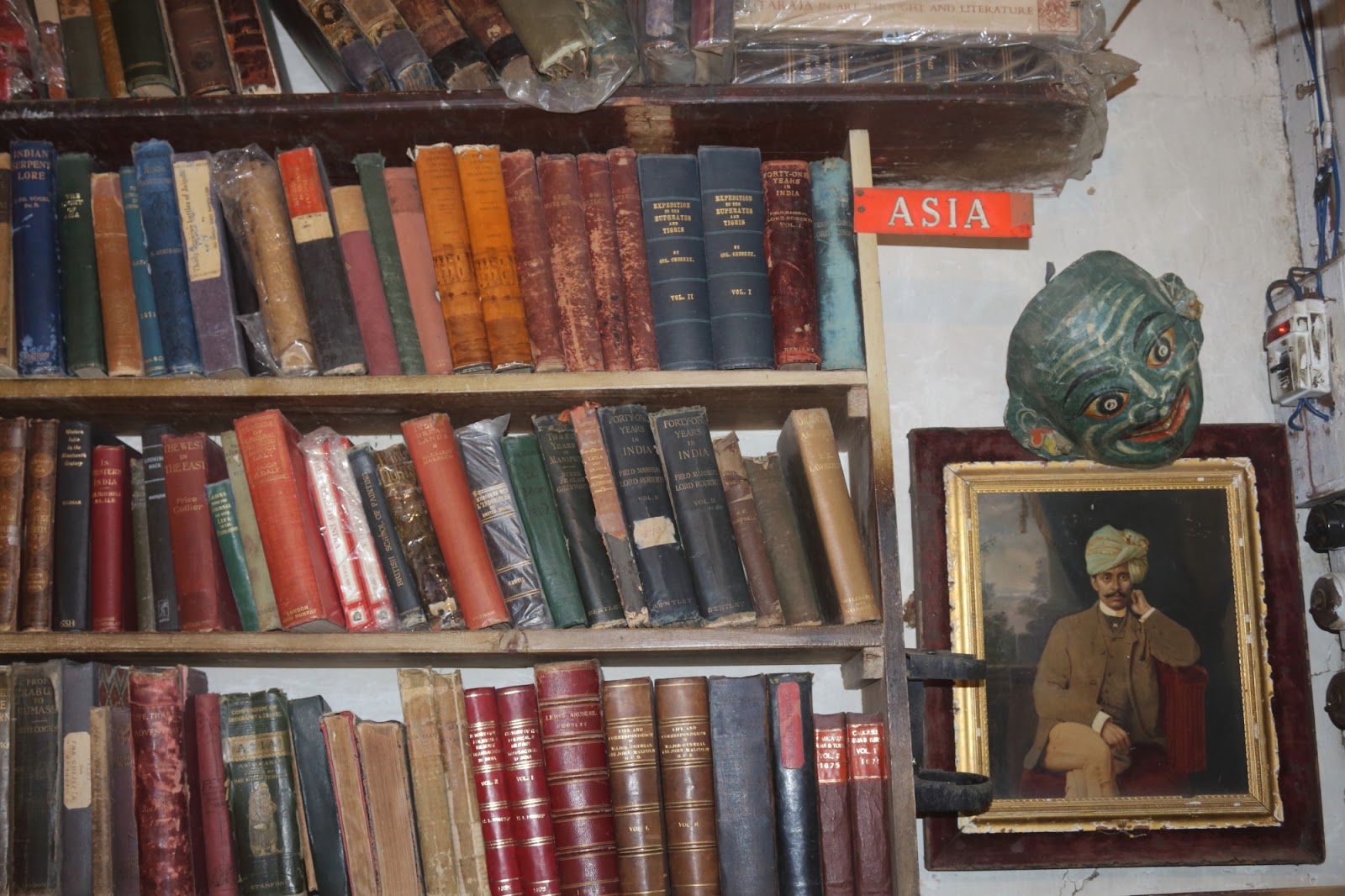
While lot changes in hill-stations in the name of tourism, lot remains the same. Settlers and residents are loath to change their old way of life. Therefore, over a period of time, some shops and businesses become institutions riding on their reputation and word-of-mouth publicity. Maria Brothers is one such iconic presence. A hole-in-the-wall bookshop on the Mall Road, it specialises in rare and antiquarian books. I remember visiting it many moons ago and coming away mesmerised with its collection. I was eager to see how it fared two decades hence.

The shop is in disarray with worn out books (some even termite-ridden) shoddily stacked on shelves. Books are literally going to dust even as the prices are going through the roof. The titles though are a million bucks. There are some antiques and lithographs covered in layers of dust. Prints of Amrita Shergill’s work catch my eye. The artist had stayed in Shimla for a while and painted the poor ‘Pahari’ (hill) people for whom she developed great compassion.  For salaried customers like us, the prints are sorely out of reach.

Rajiv Sood, one of the brothers and co-owners, is manning the shop. With a scraggly stubble and thick glasses, he looks old and beaten. There is an air of aloofness about him or to be charitable, perhaps he was having a bad day. I overhear him talk on the phone about his eyes troubling him. I push past his reticence and ask if tourists visit his shop like before. “No one reads books anymore,” he rues. Book collectors too are fading away. Time was when he used to source books from across the globe; not anymore.

The shop is resting on its laurels and not keeping up with changing times. The owner needs to do some serious stock-taking. The prices need to be reduced and the books put up for sale or auction before the termites consume them. Books that can be salvaged need to be refurbished, others that are far gone should be dumped. It would be a colossal waste to let the treasures come to a naught. It’s not doing great for the shop’s reputation and credibility, either.  


MINOCHA BROTHERS

Another such institution is Minchy’s at Lower Bazaar. The market is a maze of winding roads with old rickety buildings sticking out haphazardly. The tangle of wires overhead adds to the cluttered feel of the busy street down below. We are here to pick up pickles and preserves made from local products. Minchy’s is not your swank shop with gleaming glass top and counters. It is part of the nondescript Minocha Ghee store, the humble beginning from which Minchy’s grew. Colourful bottles and jars with “Minchy’s” branded on them assure us we are at the right place. An old gentleman welcomes us heartily; Mr. Minocha, the owner, is happy to know we belong to the naval fraternity.

We are treated to litchi juice which tastes like fresh fruit. Mr. Minocha carries on his sales spiel even as he regales us with his life-story. He came to Shimla from Lahore nearly 45 years ago when the hills were a different place altogether. He talks fondly about his daughter and daughter-in-law. The daughter-in-law, Sonia, is enterprising and makes pickles at home that are sold under her name. Minchy’s speciality is the Lungru pickle made from fiddlehead fern. He extols the virtues of their wines made from plum, peach, apricot, apple, and rhododendron in the same breath as declaring his distaste for Goan feni. He is truly happy to talk to us and says so time and again. Perhaps, the fact that we are chatting with him with no hurried agenda, unlike other tourists, makes him feel special.

As we step out of the shop laden with foodie-goodies, my gaze turns upward. Rising above the chaotic hill town, Lord Hanuman appears out of the clouds, like a chimera. It is a moment of epiphany. Shimla’s guardian angel is looking over it.

-------------------------------------------------------------------------------------------------------


-------------------------------------------------------------------------------


ALSO READ: Shimla in the Rains - I  - ("Olive" Green) 

More Wildflowers at: https://padmaja-earthletters.blogspot.com/2018/09/niche-flora-in-shimla.html


ALL PHOTOGRAPHS IN THIS BLOG AND WEBSITE ARE THE AUTHOR'S ORIGINAL WORK/COPYRIGHT


Tuesday, June 12, 2018

THE WAITING GAME


We are waiting for Sonam. The driver-guide duo has desired so. I am new to the game and being a slow starter, in any case, prefer to ‘wait’ and watch. My gypsy is one among several which is poised by a small waterbody awash with egrets. It is 3.30 p.m. and the mercury is rising over 40 ºC. A Gaur is cooling off in the shade even as a sambar peeps out from the thicket venturing towards the waterhole, cautiously. Another one follows. Sonam is snoozing amidst bamboo bushes. The scorching summer has thinned the grass, yet she remains obscured. Only the experienced guide can see the hint of stripes through the twig tracery. Sonam is oblivious of the spectators at the ringside. Everyone is hoping and wishing that she comes out for a drink. Time is ticking away even as it stands still.

Sonam is a tigress and this is her territory. This is my first jungle safari in Maharashtra’s famed Tadoba Andhari Tiger Reserve. The waiting game has just begun. Tourists are waiting to catch a glimpse of the tiger in the wild. Meanwhile, the sambars retreat and in come the monkeys. Hanuman langurs - mothers and babies, pesky juveniles and rogue males - enliven the scene with their antics. Gaurs troop in herds, but no sign of Sonam waking up. Chips, cookies and colas pop up all around. Tourists are lulled into chatting with each other and light banter ensues between the guides. After nearly an hour, I start to get restless; minutes are ticking away and I haven’t even seen the forest yet. Half of the safari has been spent in waiting for Sonam. I finally take the reins in my hands and decide to move on to explore other bounties.


The drive through the bamboo-flanked road lures us into the jungle. Deep inside there are majestic Mahua trees, the quintessence of jungles of Central India. Unfortunately, the flowering season is behind us. The sloth bears who love to feast on the mahua flowers are, therefore, scarce too.  The tree is beginning to bear fruits though.  These are last days of summer; we are mercifully at the cusp of monsoon season. We are also at the cusp of change of tourist season. By end-June the park will close for three months of rains. We are the few straggler-tourists lucky to have beaten the rush-hour frenzy.

The showers of the previous night have lowered the temperature and the morning safari on Day 2 starts on a fresh note. The drive is suffused with the heady perfume of Parijat or wild jasmine. At Agarzari range, the brash driver, who is better ‘guide’ than the guide himself, promises to introduce us to Madhuri. As we are driving along an earthen path wondering why no other vehicle is in sight, the guide gets information of Madhuri’s movement, on his primitive cell-phone. We turn around and soon figure out where the other gypsies have been. The action is happening right next to the main gate.

Madhuri is stalking a sambar in the bamboo thicket. This time round the visibility is better. The sambar is browsing cautiously and carelessly, by turns, almost as though shrugging any sense of danger. Sambars have poor eyesight so it can’t see the tigress that is virtually within 10 metres of it. We could see Madhuri inch forward stealthily half paw (held mid-air) at a time, in a real-life slo-mo clip. Another sambar joins the first doubling the chances of Madhuri's meal. Somewhere, the brainfever bird is entreating the rain gods for some respite from the heat.


In what seemed like eternity, Madhuri would stop in her tracks assessing the situation and distance before making another silent move. The sambars were now comfortably browsing away. In a moment of weakness and haste, Madhuri over-steps and the sambars are alerted. They simply balk and jink few steps away. They don’t need to run for their lives like the impalas hunted by cheetahs in savannas. The moment the tiger’s presence is sensed or it is spotted, the game is up. We could hear the tigress growl her disappointment as she slunk away deep inside. A Grey Junglefowl crowed loudly from the forest innards as though mocking the king. The apex predator too has its failures, far too many.

For the tourists, the game was still on. The jeeps revved and lined up on the adjacent road anticipating the tigress’ next move. The guides were there exactly for that reason. Our driver had something else up his sleeve. He moved away from the gypsy ‘herd’ and asking us to hold tight, took off. The next 10 minutes or more we hurtled on the murram road at 80 kph, our gypsy a Formula one racing car. It was edge-of-the-seat excitement, alright. The adrenalin was flowing, despite myself, even as a sense of unease gripped me. We arrived at a spot of open grassland face-to-face with the entourage we left behind! We had missed Madhuri by inches; she had crossed the path minutes ago. The others were lucky… but they hadn’t had enough yet.

Unrehearsed yet synchronised, all vehicles reversed and made to the gate. The tiger was headed outside the park on tar road to cross over to the adjoining range. Before I knew what was happening, vehicles were pulling up by the gate. Some youngsters with their ‘bazookas’ jumped out even before their gypsy pulled over and made a dash for the gate. The opportunity to shoot a tiger on the road in broad sight was unmissable. My driver urged me to get out too. That is when I put my foot down firmly, figuratively speaking. I was not going to do anything unethical in the pursuit of tiger-spotting. I am sure the driver and the guide thought I was a chicken!

Not the one to be discouraged the brash driver took us to a nullah to Maya’s territory. We could sense the cat with her cubs, see their apparitions, but none too clear. Therefore, we moved again to yet another spot, yet another gypsy congregation, yet another wait. An Indian Pitta pair was whistling nearby as it busied itself with nest-building. The pittas are local migrants who come from Ratnagiri to the safe haven of Tadoba for breeding, informs the guide. Few Jungle Babblers were blabbering about even as hush descended on the waiting parties. As we stood cameras primed and trained on the road, four cubs trooped out from the thicket, one by one. The three females gambolled across with ease and elan, the male scampered like a scaredy-cat! I managed to shoot the cubs and even watch them, even as vehicles edged each other out in a bid to secure the best spot. The collective sense of satisfaction and satiation was almost palpable in the air. I knew the tourists would go home happy today.


I pined for more diverse experiences, such as witnessing the majesty of the Ghost tree for the first time. The peeling bark of the Sterculia urens stands stark white on moonlit night, its twisted twigs and boughs appearing ghost-like, hence the sobriquet. The Crocodile Bark Tree or Indian Laurel is the other distinctive majestic presence in the forests. By my fourth safari, I was getting to be on top of the game. No more was I at the mercy of the driver or the guide, brash or otherwise. No more was the King the only focal point. And it was then that the jungle revealed itself in its glory.

In the anonymity of the forest, away from humans, a peacock was dancing, its feathers unfurled – a green bush amidst the dun, dry vetiver grass. Perhaps, it was trying to attract a female, but there wasn’t any around. More likely, it was dancing in joy at the promise of rains. The Pied Cuckoo, ever the harbinger of monsoon, wooed us with its dulcet song. The Pittas joined the musical soiree. Celebration was in the air.

The serenade was breached by the urgent and persistent call of a barking deer. A tiger was in the vicinity. This was Sharmilee’s home turf, but the cat, true to her name, proved elusive. By now the guide knew that I was averse to waiting around at the cost of exploring the jungle, so we struck a compromise. We headed for Pandarpaoni meadow where another tiger had been spotted. I could take in the sights and sounds en route. Pandharpaoni was a village in the heart of the core once but has been shifted out and rehabilitated hence. Chitals punctuated the drive. Alexandrine parakeets screeched and magpie robins trilled. A monitor lizard scurried to its hole-in-a-tree home. The fire line of fresh tendu leaves stood out in contrast to the dry bamboo forest. The guide was hopeful of another chance which was not to be. All the hotspots were exhausted, no movements were detectable; the dejected guide finally resigned.


Our last safari had come to an end and we headed back. Ironically, I hadn’t given up though, for me, a safari is not about the tiger alone. I asked the guide about the significance of the name, Tadoba. Tadu is a deity of Gond tribals with a small shrine to it by the Tadoba lake. With the villages having been shifted from inside the park core, nobody ever visited it anymore. As we raced to make it to the gate on time, there was divine intervention by Tadoba himself. Striding by the lake side was a huge hulk, the notorious Matkasur. A mad scramble of jeeps ensued as they vied for a vantage spot, almost colliding into each other.

Matkasur walked nonchalantly without so much as looking at us, unaware - or perhaps aware - of its celebrity status. He crossed the road in front of the crowd, over to the hill, marked his territory and slowly turned to face us. That one glance seemed to be mocking us lesser mortals. I silently folded my arms in prayer.


All Photographs in this blog and website are the Author's Original work/Copyright. 


Tuesday, January 29, 2013

Naturally Resourceful Nation SINGAPORE

Supertree Grove at Gardens by the Bay
Singapore is one big Universal Studio with several theme parks. This thought occurred to me, not on the better known Sentosa Island, but at the island city’s latest tourist draw, Gardens by the Bay. The flower domes (propagating flora of Mediterranean region), cloud forests (montane rainforests) and state-of-the-art ‘supertree’ groves at Gardens by the Bay are a great education and recreation, for locals, particularly the young, and tourists, alright. In that, they are studio recreation of earth’s diverse and niche ecological habitats which betray gianormous effort and technological skill sets that have gone into its development. In the absence of its very own natural resources, Singapore has been resourceful enough to bring Equatorial Africa and Australian outback centrestage in its citizenry’s consciousness. 

This attitude manifests itself, particularly, in the country’s desire to showcase world flora and fauna at every available space and opportunity. Therefore, public spaces are landscaped to just the right degree and uniform shade of green. The boulevard trees, many of them consciously native, are trained to behave like the everyday vehicular traffic that sticks to earmarked lanes and regulations. The roads are flanked by majestic heritage (those hundred or more years old) trees such as rain tree and mahogany but, like our host remarked, if they do decide to spread their tentacles a bit tawdry, they are promptly pruned to size.

The famed Botanic Gardens, the original avataar of the overriding theme of  “Garden city”, are the cultural legacy of the British with their penchant for manicured green spaces. They were envisaged early on in the initial town plan by Sir Stamford Raffles, the ‘founder’ of Singapore. So while they do host indigenous dipterocarps of the primary rainforests, the gardens are actually a tribute to world tropical diversity. The same goes with the breathtakingly beautiful National Orchid Garden which boasts of nearly thousand species of tropical orchids. Like much else Singaporean, technology and innovation is deployed here too, to create new hybrids. It is therefore, apt, that the national flower of Singapore is a hybrid - Vanda Miss Joaquim, eponymously named after its creator. Of course, the world-renowned orchid garden is still a rich repository of wild orchids, the last vestiges of the lowland rainforests that the island was once covered in. 

Singapore was once a tropical island rainforest, but the urban sprawl saw it diminish greatly. Today, only a small pocket lies preserved in the Bukit Timah Nature Reserve, which unfortunately, I did not get to see. To meet the demands of the increasing population, urban Singapore has had to reclaim nearly 200 sq. kms of land from sea. On the one hand, Singaporeans seem to be spending little time on procreation and the “precious jewels” (the natural resource of children) are becoming scarce. The state has to woo and incentivise couples to bear more children. On the other hand, the government has opened its borders to immigrants. That, in turn, has led to disgruntlement among the settlers and the new generation who feel that migrants dilute the fabric of Singapore society. Today, Singapore has one of the highest population densities in the world! To accommodate its people the Housing Development Board (HDB) develops high rises at dizzying speed as housing is a national priority. This has seen verticalization of, not only buildings, as one might expect, but even horticultural farms!

In my 10-day sojourn in Singapore I saw crows, mynas, pigeons and orioles on my regular jaunts, but not much else, despite the verdure. I thought Jurong Bird Park would educate me on the local avifauna but I should have known better by now. JBP, too, is a cauldron of different bird species of the world, from turacos to toucans. The highly popular High Flyers’ show featuring macaws and cockatoos of the Amazon rainforest, though spectacular, left me feeling a bit low. The birds were shitting time and again, nervous as they obviously were performing in front of a mass of humanity. I shuddered to think what rigour  they had to undergo and over what workday they had to rehearse such a precise and synchronized show. At the other show, King of the Skies, which featured predatory birds – hawks and vultures – I could see the leash on the birds’ feet! The exhibits were even more depressing though the enclosures were squeaky clean and the birds well-fed. The ‘World of Darkness’ enclosure of owls proudly claimed: “Enter the darkness of night, in broad daylight…” Imagine seeing the owls in dim light in broad daylight; owls are nocturnal but they do not stay in darkness whole day long. The scarlet ibis (looked like flamingoes to me!) looked sadly out of place on the faux wetlands at the Park. But, it also set me thinking. Were these minority specimens not any different from the migrants that came to Singapore from erstwhile Malaya, or India or China? Migrants, who got uprooted from their native land and were transplanted into an alien culture and habitat due to unforseen circumstances? And who over a period of time, over generations, got naturalized to a new foreign identity, like the Peranakans, perhaps? They are no different from migrants of yesterday who become today’s card-carrying citizens imbuing the city-state with entrepreneurial energy and can-do attitude!


Back to pavilion after the show as the free-spirit myna (above right) looks on

 After these encounters with nature, I was glad I did not go to the Singapore zoo and night safari. It would be an understatement to say that after my safari in Kenya’s Maasai Mara, this would have been a come down. For a country that has little wildlife, such attempts to procure and display wildlife, may be commendable, but also puerile. 

Having done the tourist circuit, I am glad we went off the beaten track, to visit the Marina Barrage, as it took me closer into the psyche of a nation that is environmentally conscious and concerned. I truly admired the chutzpah of the nation that imports 50% of its water requirement from neighbouring Malaysia, its ambition to achieve self-sufficiency in water supply in the coming years. For some reason, Singapore does not have a sustainable groundwater table, so currently its water needs are satisfied by desalination plants, apart from water imported from Malaysia as per two bilateral accords. The Public Utility Board, the national water agency, is not hedging its stakes entirely on its neighbour and has built several reservoirs and water catchment areas for harvesting rainwater. Marina Barrage, the latest reservoir doesn’t just collect rainwater but also prevents flooding by separating seawater from freshwater. This project is not just a staid state project operating behind-the-scenes, it is an engineering marvel that is being peddled as prime recreation club. Even from where we stand we can see youngsters flying kites from the green roof terrace of the Barrage complex. Children play in water and families get together for sailing and other water sports over weekends, we are told. When they do so, they also visit the Sustainable Gallery which is a “sensory extravaganza” to educate public on importance of water cycle and water recycling.

Green roof-top terrace of Marina Barrage overlooking Singapore skyline

What is particularly commendable about PUB’s efforts is that they realize the importance of self-reliance when it comes to generating this precious resource, especially in the light of history of strife with its neighbour from which Singapore separated to form an independent nation. And they make every drop count. Thus, recycling used water and treating it for reuse for industrial and even, household purposes, is also top on the agenda. Recycled water, currently meets 30% of Singapore’s water needs. The PUB product NEWater is high-grade bottled ‘treated waste water’ which surpasses WHO requirements for drinking water. The PUB has designed and developed an ambitious programme for generating water resource and is co-opting NGOs to spread awareness and take the message across its people. Today, Singapore is recognized as a model city for good water management and is global hydro-hub (which means it has domain expertise in water management and is in a position to share it with or help water-stressed countries). PUB won the 2007 Stockholm Industry Water Award “for their holistic approach to water resources management which made water use sustainable for different sectors of society in a unique and challenging urban island environment.”

Singapore is singularly wanting in natural resources as illustrated above but that hasn’t hampered or hindered its progress in any way. In fact, precisely for that reason, today, it values them more and is conscious of environmental housekeeping. The nation, by nature, is resourceful enough to tide over the shortfall and create plenty.