
The news item of the barbaric slaughter of
Satao - a rare bull with nearly 50 kg of tusk (each) grazing the ground – by poachers
caught my eye and made my heart bleed. Visions of African Elephants - tuskers
and matriarchs, calves and juveniles – that I had seen in the diverse ecological
habitats of Kenya - from the plains to the forests - swam in front of my eyes.
Satao was a Tsavo bull and it was here in the vast historic savannas of Tsavo that
I had my initial tryst with the species Loxodonta
Africana.
RED ELEPHANTS OF TSAVO
En route from Mombasa to Nairobi early in our Kenya sojourn, we decided to take a detour into Tsavo territory. Tsavo National Park is Kenya’s largest, divided into East and West, East being the wilder and less frequented of the two.
In the lazy noon hour, the park seemed devoid
of animals though the bush was buzzing with birds. We had almost given up hope
after a few hours when the elephant parade began! Being intimately acquainted
with the Indian elephant, which is grey-black, the first sight of (brick) ‘red’
elephants was truly exceptional. It is Tsavo’s rich volcanic soil, ochre in colour,
which gives elephants that distinctive hue when they wallow or bathe in mud.
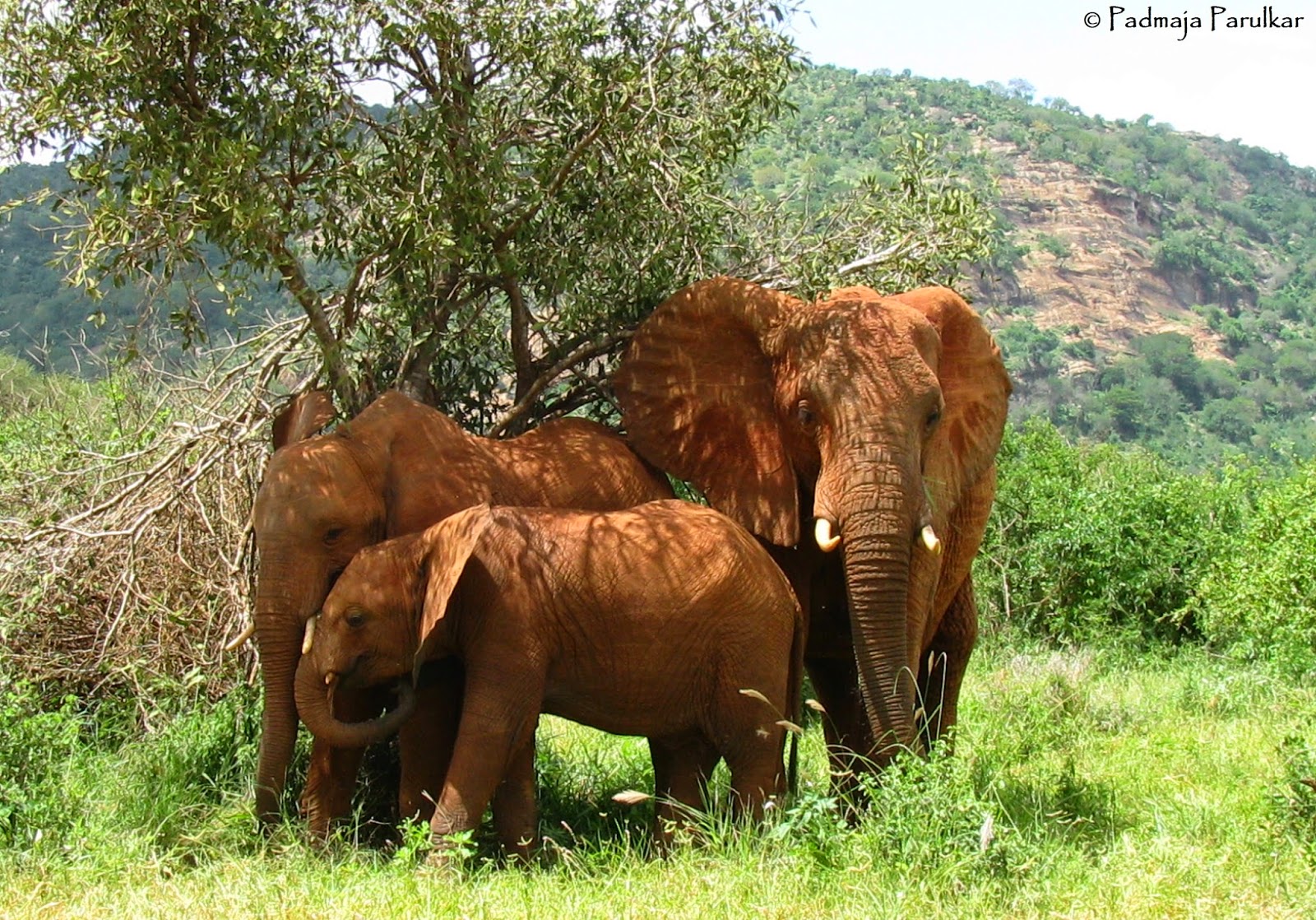
In the blazing equatorial sun, we came upon a
“nuclear” family trying to shield them under/near a sparse shrub, barely
managing to tuck their heads in! That classic sight was a testimony to the species’
qualities of tolerance and accommodation of others.
Much later, when we visited Tsavo West, the
trails we followed threw up elephant hooves, intermittently, but not their
owners. Bare boles of acacias stripped of leaves and twigs stood as signs of
elephant ravages, but the perpetrators of carnage were nowhere in sight. That
is how it is in Tsavo country, the excitement lies more in the suggestion than
in the spotting.
After hours of following the red dirt tracks
through the acacia-commiphora woodlands all we could see was a herd of
elephants walking into the horizon. Should a small herd of elephants walking
away into distance - a pastiche at once of mundanity and mystery - be any less
thrilling than an elephant at close quarters posing for a photograph? For me,
this is a more intimate portrait, almost as if the elephants were leading me
into their private domain, if only I exerted my imagination and followed them
there.

***************************
ELLIES OF AMBOSELI!
It was March of 2009; the year of drought in Amboseli. Nyika or
African bush is largely treeless and hence can be punishing in its natural elements
at the best of times. In such a parched landscape, the scene that stayed with
me was this: a long-shot of lumbering herd of elephants with young ones in tow
cutting through the simmering heat of the dustbowl in search of water.
This
family would have to walk for miles to get to the receding water sources and it
would have to do it as fast or slow as the pace of the youngest calf. We, who
simply reach out for bottled water or a can of coke in the middle of nowhere, to
wet our lips or soothe our parched throats, cannot even begin to imagine the
herd’s predicament. The poignancy of the scene lay in the realization of that
harsh reality of life in the wild.

As the herd approached our vehicle the calf buckled under sheer
exhaustion and lay down to rest: the clan simply stayed put in some sort of
protective formation. They stood freeze frame for what seemed like an eternity and
we waited with bated breath to see what would happen next. As my son
interpreted the scenario, the calf that was resting was the unlikely king, and
the family of adults, the servile subjects who had to wait it out. I felt as
though the earth had stopped spinning and that instant was IT… for the
elephants there was no past, no future; the essence of existence was the
present moment – poised between life and death.
The elephant herd would pause for as long as it would take the
calf to regain its energy before resuming their long march. We, however, had to
move on so as not to overstay safari propreity and had no way of knowing the
fate of the calf or of the clan. But, possibly, the entire family would have
had to go without water longer than their tolerance threshold, or perhaps I was
underestimating their patience and endurance.
DIONYSIUS
The sight of an imposing lone tusker is worth more than a pride of
lions (so to speak!) and we were lucky to see one at a distance near the
Olokenya swamp. (Later through the film “Elephants Memories” by Dr. Cynthia
Moss we got to know that this was the legendary Dionysius).
The mammoth, his
tusks tending to ground, emerged out of a thicket like a chimera. Surprised or
simply gauging our mood as we were trying to sense his, he stood there looking
directly at us. Even from that distance we could feel his brute presence, a
colossus striding the earth like royalty. Suddenly, contrary to its nature, it
darted into nearby bushes and simply vanished before our eyes. It was as though
the mask had been ripped off his face and the blinkers off mine as I realized
how vulnerable that lone ranger was. No companion, no family, no herd – a persona non grata eking it out in an unfriendly world.

*******************
CLOSE ENCOUNTER AT MANYARA
Even as we had started on our game drive in
Lake Manyara National Park in Tanzania, two young frisky elephants feeding by
the roadside blocked our path. I was consternated at the sight of one of them
fanning its ears menacingly and for once the cocoon of our vehicle seemed
vulnerable. What a contrast, I couldn’t help comparing, with Ian Douglas
Hamilton’s (Lake Manyara was this elephant-expert’s playing field) bravado in
undertaking the hazardous task of photographing elephants with ears spread out,
for identification, at times crouching on trees or even on foot!
Not wanting to antagonise them, the driver
backed off. Finally, they slipped into the thicket clearing our way. Back at
our resort, the hotel staff was emphatic that no game strayed in there as the
lodge was outside the National Park, though we had seen some bushbuck stroll
below our balcony.
By dusk, after the game drive, elephant
blockade fresh in mind, we sauntered into the lodge chatting away walking up to
the room. Fellow lodgers - a couple – waved a hello or so we thought; instead
they greeted us, saying: “Look there, by the (swimming) pool… Elephants”!
My heart stopped beating as I saw two grey apparitions
appear over the curve of the hill. They walked towards the same direction as
us, parallel to us, the lodge rooms dividing our paths. Our friends turned to
their room leaving us alone to decide our fate. Silently, we kept walking,
praying, and managed to reach our rooms safely. The wind Gods had aided us.
From the
first floor balcony, just in time, we caught a herd of three, including a calf,
within whispering distance! I shudder to think, what would have happened if our
family of three (me, my husband and son) had come face to face with the
elephant trio.
**************
It was much later in Kenya’s Aberdare forests that
I was lured into the secret universe of the elephants where I was witness to
their legendary bonding.


Read Slow Dance of the Elephants
ALL PHOTOGRAPHS IN THIS BLOG/ BLOGSPOT ARE THE AUTHOR'S ORIGINAL WORK/ COPYRIGHT


