JAKHU HILL
 Sitting
at ‘Under Tree’, atop Jakhu Hill, I watch the thick mist roll over the deodar forest as I sup on steaming soup. At more than 8000 ft, this is the highest
peak in Shimla. The rain adds an ethereal element to the atmospherics and it
feels like I am floating on clouds. Troops of macaques and langurs are roaming
freely; we are the ones caged in our glass-house cafe. It’s an apt reminder
that the monkeys are the earliest denizens of Shimla from the time when the
hills, “…(some of which) have remained untrodden since creation", as Emily Eden,
sister of Governor General Lord Auckland documented. Long before the British arrived,
there was a shrine to Lord Hanuman on “Mount Jakko”, the original location of
Old “Shyamala” village from where the hill-station, arguably, gets its name. The
Hanuman temple that stands here today must have gone through several avataars over this period.
Sitting
at ‘Under Tree’, atop Jakhu Hill, I watch the thick mist roll over the deodar forest as I sup on steaming soup. At more than 8000 ft, this is the highest
peak in Shimla. The rain adds an ethereal element to the atmospherics and it
feels like I am floating on clouds. Troops of macaques and langurs are roaming
freely; we are the ones caged in our glass-house cafe. It’s an apt reminder
that the monkeys are the earliest denizens of Shimla from the time when the
hills, “…(some of which) have remained untrodden since creation", as Emily Eden,
sister of Governor General Lord Auckland documented. Long before the British arrived,
there was a shrine to Lord Hanuman on “Mount Jakko”, the original location of
Old “Shyamala” village from where the hill-station, arguably, gets its name. The
Hanuman temple that stands here today must have gone through several avataars over this period.  In 2010,
a 108-feet tall idol was erected in the temple premises which, more often than
not, stays cloaked in mist and is a big draw with the tourists. We have a
special affinity to Hanuman as he is my husband’s family (village) deity from
where the family gets its name. Here, the errant macaques have right of way. If
you are not careful, they will run away with your footwear or some other
accoutrement. The trick is to offer a packet of chana and bribe the culprits into returning the stolen items. One
old man had to bid goodbye to his glasses. He followed the drill but even as he
offered the customary chana, he
hastened to snatch the glasses. Displeased, the rogue ran away with both!
In 2010,
a 108-feet tall idol was erected in the temple premises which, more often than
not, stays cloaked in mist and is a big draw with the tourists. We have a
special affinity to Hanuman as he is my husband’s family (village) deity from
where the family gets its name. Here, the errant macaques have right of way. If
you are not careful, they will run away with your footwear or some other
accoutrement. The trick is to offer a packet of chana and bribe the culprits into returning the stolen items. One
old man had to bid goodbye to his glasses. He followed the drill but even as he
offered the customary chana, he
hastened to snatch the glasses. Displeased, the rogue ran away with both!
OLD SHIMLA –
Hill-stations
are charged with nostalgia. The history of a place comes alive, primarily, in
its heritage buildings and museums. Shimla was the summer capital of India
during the imperial era. The British took residency here leaving behind a
legacy of colonial houses, but a lot of wealthy Indians settled here, too.
Rajkumari Amrit Kaur was one such prominent personality who had an abode in
Summer Hill, called Manorville Mansion. Descendant
of Maharaja of Kapurthala, she served as one of Gandhiji’s private secretaries
for more than a decade and was in the forefront of the freedom movement. She had
the distinction of being the first woman Cabinet Minister (Health) of
independent India. The All India Institute of Medical Sciences was her initiative.
 It took
us a while to locate the bungalow, but there it was - Rajkumari Amrit Kaur
Bhavan - in the heart of Himachal Pradesh University Campus, a guesthouse for
AIIMS personnel. Painted in signature red and white as other heritage houses in
Shimla, this colonial bungalow sits amidst conifer forests overlooked by Summer
Hill. We had come to see the house out of curiosity, but hit upon a minefield.
It took
us a while to locate the bungalow, but there it was - Rajkumari Amrit Kaur
Bhavan - in the heart of Himachal Pradesh University Campus, a guesthouse for
AIIMS personnel. Painted in signature red and white as other heritage houses in
Shimla, this colonial bungalow sits amidst conifer forests overlooked by Summer
Hill. We had come to see the house out of curiosity, but hit upon a minefield.
The
Bhavan is a memorial to Mahatma Gandhi who stayed here, off and on, over several
years when he visited Shimla on political sojourns. Two rooms are dedicated in
his memory−his workplace with a desk and a modest bedroom where he would
retire. Memorabilia such as crockery and archival photographs of political
events brought the era alive. With a little bit of imagination, I was
transported to moments in history; Gandhiji having discussions with Nehru and
Patel or waving out, from the balcony, to the people who had gathered outside. Interestingly,
Manorville with its mossy walls and wildflower proved a pitstop for my penchant for macro photography.


SUMMER HILL RAILWAY STATION

A friend
suggested a visit to the quaint Summer Hill Railway Station to fulfil my
photography cravings. The station on the narrow-gauge Kalka-Shimla line is a
relic from the past. Standing on the bridge looking down at the platform, I
felt it wasn’t half as enchanting as Coonoor railway station in the Nilgiris.
To get away from the drizzle, we scampered to the platform for shelter. As we were strolling around, a young “gentleman”−all suited up with a fedora hat to boot−approached us. For a moment, it seemed like we had stepped into a time machine. In clipped, albeit desi-accented English, he wanted to know what we were looking for. He seemed wary of our intrusion, but soon Sushil Kumar, the station-master, warmed up to us. He was all praise for the British and their legacy of railways which he thought “we corrupt Indians are not worthy of”.
To get away from the drizzle, we scampered to the platform for shelter. As we were strolling around, a young “gentleman”−all suited up with a fedora hat to boot−approached us. For a moment, it seemed like we had stepped into a time machine. In clipped, albeit desi-accented English, he wanted to know what we were looking for. He seemed wary of our intrusion, but soon Sushil Kumar, the station-master, warmed up to us. He was all praise for the British and their legacy of railways which he thought “we corrupt Indians are not worthy of”.
As
though to testify, he welcomed us to his cabin that was virtually a recreation of the bygone era. Unfortunately
for me, photography was not permitted inside. He demonstrated how the old-world
signalling system and telephone line was operated. Once the green signal was
confirmed and locked for an oncoming train, a token was generated. He demonstrated
how the token was put in a ring for the pointsman to hand it over to the incoming
locomotive’s driver. It was a failsafe method, “visionary” of the British, he maintained.
Every time the phone rang, the “brown sahib” rose up to his full stature, in a
manner of speaking, and greeted: “Summer Hillla…” in an unmistakable Punjabi
twang, letting his guard slip.
MARIA BROTHERS
While
lot changes in hill-stations in the name of tourism, lot remains the same.
Settlers and residents are loath to change their old way of life. Therefore,
over a period of time, some shops and businesses become institutions riding on
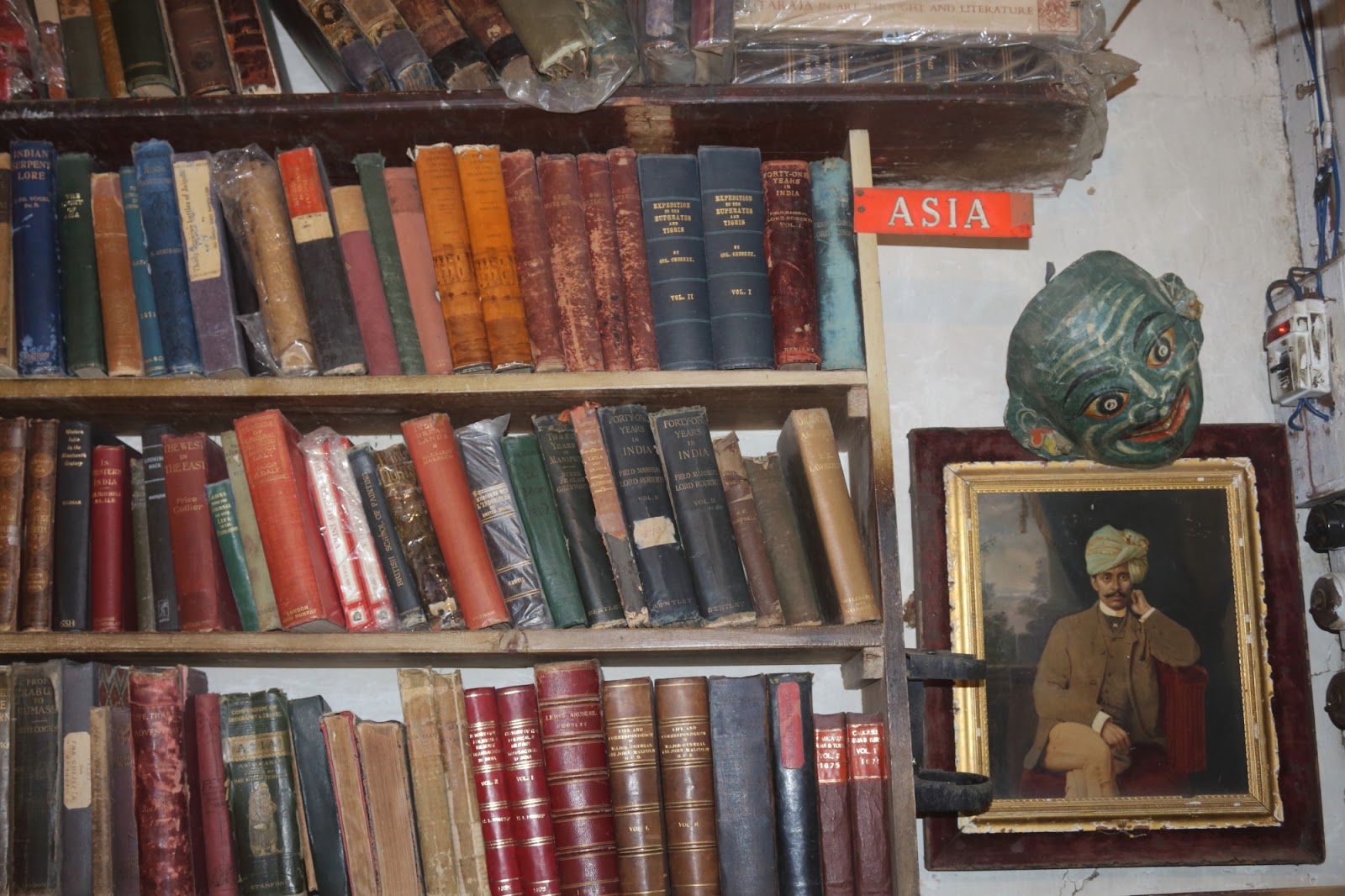
their reputation and word-of-mouth publicity. Maria Brothers is one such iconic
presence. A hole-in-the-wall bookshop on the Mall Road, it specialises in rare
and antiquarian books. I remember visiting it many moons ago and coming away
mesmerised with its collection. I was eager to see how it fared two decades hence.
The shop
is in disarray with worn out books (some even termite-ridden) shoddily stacked
on shelves. Books are literally going to dust even as the prices are going
through the roof. The titles though are a million bucks. There are some
antiques and lithographs covered in layers of dust. Prints of Amrita Shergill’s
work catch my eye. The artist had stayed in Shimla for a while and painted the
poor ‘Pahari’ (hill) people for whom she developed great compassion. For salaried customers like us, the prints are
sorely out of reach.
Rajiv
Sood, one of the brothers and co-owners, is manning the shop. With a scraggly
stubble and thick glasses, he looks old and beaten. There is an air of
aloofness about him or to be charitable, perhaps he was having a bad day. I
overhear him talk on the phone about his eyes troubling him. I push past his
reticence and ask if tourists visit his shop like before. “No one reads books
anymore,” he rues. Book collectors too are fading away. Time was when he used
to source books from across the globe; not anymore.
The shop
is resting on its laurels and not keeping up with changing times. The owner needs
to do some serious stock-taking. The prices need to be reduced and the books put
up for sale or auction before the termites consume them. Books that can be
salvaged need to be refurbished, others that are far gone should be dumped. It
would be a colossal waste to let the treasures come to a naught. It’s not doing
great for the shop’s reputation and credibility, either.



MINOCHA BROTHERS
Another such
institution is Minchy’s at Lower Bazaar. The market is a maze of winding roads with old rickety buildings sticking out haphazardly. The tangle of wires
overhead adds to the cluttered feel of the busy street down below. We are here
to pick up pickles and preserves made from local products. Minchy’s is not your
swank shop with gleaming glass top and counters. It is part of the nondescript
Minocha Ghee store, the humble beginning from which Minchy’s grew. Colourful bottles
and jars with “Minchy’s” branded on them assure us we are at the right place.
An old gentleman welcomes us heartily; Mr. Minocha, the owner, is happy to know
we belong to the naval fraternity.
 We are
treated to litchi juice which tastes like fresh fruit. Mr. Minocha carries on
his sales spiel even as he regales us with his life-story. He came to Shimla
from Lahore nearly 45 years ago when the hills were a different place
altogether. He talks fondly about his daughter and daughter-in-law. The
daughter-in-law, Sonia, is enterprising and makes pickles at home that are sold
under her name. Minchy’s speciality is the Lungru pickle made from fiddlehead
fern. He extols the virtues of their wines made from plum, peach, apricot,
apple, and rhododendron in the same breath as declaring his distaste for Goan feni. He is truly happy to talk to us
and says so time and again. Perhaps, the fact that we are chatting with him
with no hurried agenda, unlike other tourists, makes him feel special.
We are
treated to litchi juice which tastes like fresh fruit. Mr. Minocha carries on
his sales spiel even as he regales us with his life-story. He came to Shimla
from Lahore nearly 45 years ago when the hills were a different place
altogether. He talks fondly about his daughter and daughter-in-law. The
daughter-in-law, Sonia, is enterprising and makes pickles at home that are sold
under her name. Minchy’s speciality is the Lungru pickle made from fiddlehead
fern. He extols the virtues of their wines made from plum, peach, apricot,
apple, and rhododendron in the same breath as declaring his distaste for Goan feni. He is truly happy to talk to us
and says so time and again. Perhaps, the fact that we are chatting with him
with no hurried agenda, unlike other tourists, makes him feel special. As we step out of the shop laden with foodie-goodies, my gaze turns upward. Rising above the chaotic hill town, Lord Hanuman appears out of the clouds, like a chimera. It is a moment of epiphany. Shimla’s guardian angel is looking over it.
-------------------------------------------------------------------------------------------------------


-------------------------------------------------------------------------------
ALSO READ: Shimla in the Rains - I - ("Olive" Green)
More Wildflowers at: https://padmaja-earthletters.blogspot.com/2018/09/niche-flora-in-shimla.html
ALL PHOTOGRAPHS IN THIS BLOG AND WEBSITE ARE THE AUTHOR'S ORIGINAL WORK/COPYRIGHT


