Showing posts with label Africa. Show all posts

Friday, June 20, 2014

Slow Dance of The Elephants

The Aberdare Experience

Aberdare Ark is a modern-day machaan, except that it is a building (shaped in an ark) with all amenities afforded to tourists for a comfortable stay! It sits next to a natural salt lick in a clearing within the lush Aberdare tropical forests of Kenya. The Ark has a viewing gallery in the basement where one is level with the waterhole, a terrace which gives one an overhead view and a mezzanine lookout which is barely clear of the tallest elephant’s height!

When we reached the Ark it was approaching sunset, a perfect time for animals to congregate at the waterhole before they called it a day. An elephant parade was lined up, with some African cape buffaloes blending in, almost as though to welcome us. In the awed hush all we could hear was the odd rumble and rustle, an overwhelming assertion of life! Unlike other safaris where we encountered elephant herds browsing and feeding from time to time and took pretty pictures, the Aberdare experience was one to watch elephant behaviour and bonding, intimately, in their natural habitat.

From the terrace, I spotted a cow with a calf huddled by its side; other young ones came to caress and pet it, all the time ensuring that it was well-flanked and protected. Two juveniles from different clans came upon each other, touched and twined their trunks, and indulged in boisterous play for a while. One of the young adults had something hanging loose at the end of its trunk; it took me a while to figure that the trunk itself was mutilated and a part of it was hanging by a lip! It seemed like an old wound and the mammal was able to adapt it beautifully despite the deformity.


Elephant herds of varying strength were trooping in and out of the thicket to the waterhole. One of the young male was wounded with blood oozing from its face. You could see, it was desperately seeking attention and commiseration from others, like a little child. It would go close and try to touch every other elephant that came out of the bush. I was shocked to see that it was being shunned by one and all! To my mind it seemed like a case of adults chiding, “I told you so”, for “not listening” to sane counsel! Or maybe there was some other explanation that we have no way of knowing.

As the day wound to a close, I shifted my observation post to the open balcony by the path where the animals had to retreat into the thick vegetation. There was an embankment of boulders - two feet wide - below the balcony to keep the elephants from straying too close. Every time an elephant approached my side and passed by, it would, unfailingly, lift up its trunk sniffing my presence. But their reactions were different. Some were wary, some baulked and some actually bolted, timidly, tail in the air. I wondered how much of my olfactory signature was imprinted on their memories and if I were to encounter them out in the wild would they recognise me!


The jumbos had called it a day and all the resident tourists too retreated to their cubby-hole cabins for a doze. Being claustrophobic, I had to wait out the night somehow. Somewhere around 2 or 3 at night, I must have drowsed only to be awakened by a sixth sense. I went to the balcony to gulp in fresh air just in time to see a faint trickle of pearly grey masses coming out into the open. In the still moonlit night, for the next hour and a half, a slow dance-drama unfolded - for my eyes only - leaving me completely dazed.

A matriarch with a calf, few females and some sub-adults began confabulating by the pool. Soon the calf lay at its mother’s feet to rest and three-four grown-ups stood in a semi-circle forming a protective cover. 

The mater moved away closer to the water’s edge, sniffed the wind, and kneeled down as though checking the depth of the pool with its probing trunk. It tore away the grass growing at the edges and gobbled it. Soon it had rolled onto its side, raised its trunk, and was contorting its body! My first impression was that this animal was sick; that it might have a tummy problem. For an instant it almost seemed like it was in throes. I hadn’t seen anything so bizarre all my life! The matriarch wallowed and writhed as the herd watched respectfully from a distance, not breaking her trance.

She then strode back to its family by when the calf was up and rejuvenated. Then a slow, deliberate, rhythmic ritual ensued… trunks entangling, twining, and feeling each other. The entire herd stood still in a wedge formation with its trunks touching. After a long while, the formation turned inside out with the bottoms now jostled together. Was it a family get-together where they were narrating stories and anecdotes, trading notes and even, joking?

The calf and the sub-adult were left out of the loop, surprisingly, left unprotected behind their backs! When the calf attempted to pry from behind, curious, the matriarch without so much as a look gave it the boot sending it scurrying out of the charmed circle! With no perceived threats and comfortable in the privacy of their circle, they could now afford to keep the pesky young ones out of their adult “bedroom” conversation!

The herd stood in varied patterns and formations (interminably, it seemed!) and changed positions at intervals. If that one hour could be filmed, fast forwarded and reduced to a 15- 20-minute clip, then I would be witness to a rhythmic gyration, a slow ballet.

Was it a spiritual ceremony or a cult ritual? Or I wondered if the herd was mourning having heard and read so much about elephant’s graveyards and death rituals.

Benson, the in-house naturalist, discounted it saying that in the 40 years of the lodge’s existence no elephant had died or was buried there. He had this to say: “Elephants are highly evolved social creatures and with a lot of research being done on their memory and behaviour, scientists haven’t finished yet. I would think we haven’t begun yet.” 


ALL PHOTOGRAPHS IN THIS BLOG/ BLOGSPOT ARE THE AUTHOR'S ORIGINAL WORK/ COPYRIGHT

MY ELEPHANT MEMORIES


The news item of the barbaric slaughter of Satao - a rare bull with nearly 50 kg of tusk (each) grazing the ground – by poachers caught my eye and made my heart bleed. Visions of African Elephants - tuskers and matriarchs, calves and juveniles – that I had seen in the diverse ecological habitats of Kenya - from the plains to the forests - swam in front of my eyes. Satao was a Tsavo bull and it was here in the vast historic savannas of Tsavo that I had my initial tryst with the species Loxodonta Africana.


RED ELEPHANTS OF TSAVO

En route from Mombasa to Nairobi early in our Kenya sojourn, we decided to take a detour into Tsavo territory. Tsavo National Park is Kenya’s largest, divided into East and West, East being the wilder and less frequented of the two.

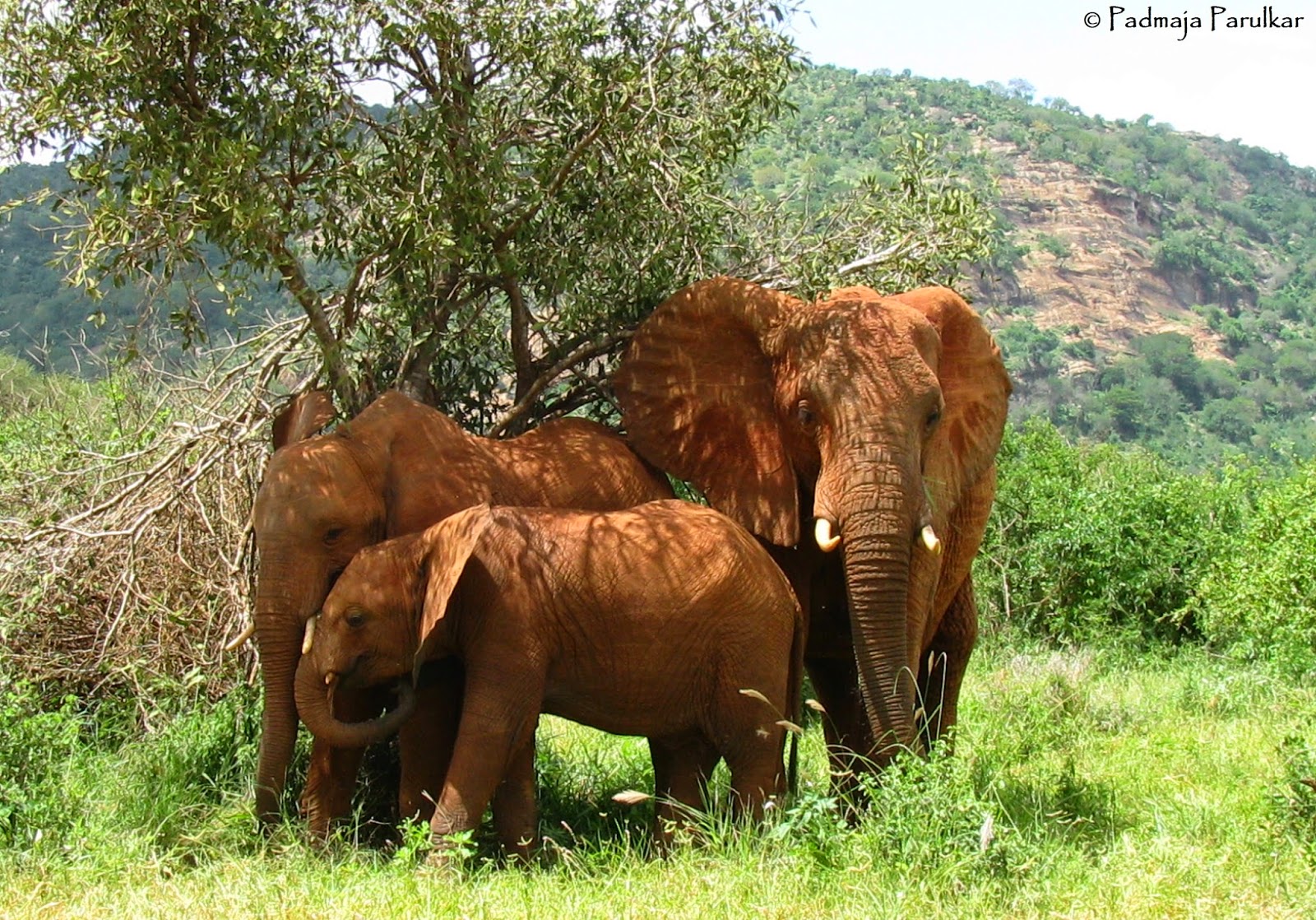
In the lazy noon hour, the park seemed devoid of animals though the bush was buzzing with birds. We had almost given up hope after a few hours when the elephant parade began! Being intimately acquainted with the Indian elephant, which is grey-black, the first sight of (brick) ‘red’ elephants was truly exceptional. It is Tsavo’s rich volcanic soil, ochre in colour, which gives elephants that distinctive hue when they wallow or bathe in mud.


In the blazing equatorial sun, we came upon a “nuclear” family trying to shield them under/near a sparse shrub, barely managing to tuck their heads in! That classic sight was a testimony to the species’ qualities of tolerance and accommodation of others.  

Much later, when we visited Tsavo West, the trails we followed threw up elephant hooves, intermittently, but not their owners. Bare boles of acacias stripped of leaves and twigs stood as signs of elephant ravages, but the perpetrators of carnage were nowhere in sight. That is how it is in Tsavo country, the excitement lies more in the suggestion than in the spotting.

After hours of following the red dirt tracks through the acacia-commiphora woodlands all we could see was a herd of elephants walking into the horizon. Should a small herd of elephants walking away into distance - a pastiche at once of mundanity and mystery - be any less thrilling than an elephant at close quarters posing for a photograph? For me, this is a more intimate portrait, almost as if the elephants were leading me into their private domain, if only I exerted my imagination and followed them there.


***************************

ELLIES OF AMBOSELI!

It was March of 2009; the year of drought in Amboseli. Nyika or African bush is largely treeless and hence can be punishing in its natural elements at the best of times. In such a parched landscape, the scene that stayed with me was this: a long-shot of lumbering herd of elephants with young ones in tow cutting through the simmering heat of the dustbowl in search of water. 

This family would have to walk for miles to get to the receding water sources and it would have to do it as fast or slow as the pace of the youngest calf. We, who simply reach out for bottled water or a can of coke in the middle of nowhere, to wet our lips or soothe our parched throats, cannot even begin to imagine the herd’s predicament. The poignancy of the scene lay in the realization of that harsh reality of life in the wild.


As the herd approached our vehicle the calf buckled under sheer exhaustion and lay down to rest: the clan simply stayed put in some sort of protective formation. They stood freeze frame for what seemed like an eternity and we waited with bated breath to see what would happen next. As my son interpreted the scenario, the calf that was resting was the unlikely king, and the family of adults, the servile subjects who had to wait it out. I felt as though the earth had stopped spinning and that instant was IT… for the elephants there was no past, no future; the essence of existence was the present moment – poised between life and death.

The elephant herd would pause for as long as it would take the calf to regain its energy before resuming their long march. We, however, had to move on so as not to overstay safari propreity and had no way of knowing the fate of the calf or of the clan. But, possibly, the entire family would have had to go without water longer than their tolerance threshold, or perhaps I was underestimating their patience and endurance.

DIONYSIUS 

The sight of an imposing lone tusker is worth more than a pride of lions (so to speak!) and we were lucky to see one at a distance near the Olokenya swamp. (Later through the film “Elephants Memories” by Dr. Cynthia Moss we got to know that this was the legendary Dionysius). 

The mammoth, his tusks tending to ground, emerged out of a thicket like a chimera. Surprised or simply gauging our mood as we were trying to sense his, he stood there looking directly at us. Even from that distance we could feel his brute presence, a colossus striding the earth like royalty. Suddenly, contrary to its nature, it darted into nearby bushes and simply vanished before our eyes. It was as though the mask had been ripped off his face and the blinkers off mine as I realized how vulnerable that lone ranger was. No companion, no family, no herd – a persona non grata eking it out in an unfriendly world.


*****************************

CLOSE ENCOUNTER AT MANYARA

Even as we had started on our game drive in Lake Manyara National Park in Tanzania, two young frisky elephants feeding by the roadside blocked our path. I was consternated at the sight of one of them fanning its ears menacingly and for once the cocoon of our vehicle seemed vulnerable. What a contrast, I couldn’t help comparing, with Ian Douglas Hamilton’s (Lake Manyara was this elephant-expert’s playing field) bravado in undertaking the hazardous task of photographing elephants with ears spread out, for identification, at times crouching on trees or even on foot!

Not wanting to antagonise them, the driver backed off. Finally, they slipped into the thicket clearing our way. Back at our resort, the hotel staff was emphatic that no game strayed in there as the lodge was outside the National Park, though we had seen some bushbuck stroll below our balcony.

By dusk, after the game drive, elephant blockade fresh in mind, we sauntered into the lodge chatting away walking up to the room. Fellow lodgers - a couple – waved a hello or so we thought; instead they greeted us, saying: “Look there, by the (swimming) pool… Elephants”!

My heart stopped beating as I saw two grey apparitions appear over the curve of the hill. They walked towards the same direction as us, parallel to us, the lodge rooms dividing our paths. Our friends turned to their room leaving us alone to decide our fate. Silently, we kept walking, praying, and managed to reach our rooms safely.  The wind Gods had aided us. 

From the first floor balcony, just in time, we caught a herd of three, including a calf, within whispering distance! I shudder to think, what would have happened if our family of three (me, my husband and son) had come face to face with the elephant trio.

*****************************

It was much later in Kenya’s Aberdare forests that I was lured into the secret universe of the elephants where I was witness to their legendary bonding.  


Read Slow Dance of the Elephants


ALL PHOTOGRAPHS IN THIS BLOG/ BLOGSPOT ARE THE AUTHOR'S ORIGINAL WORK/ COPYRIGHT

Saturday, November 3, 2012

Out of Africa in Mandovi

Mandovi Hill resembling the savannah as the monsoon retreats
Since the last shower a fortnight ago, the weather has turned. And so has the season. The land is already looking parched and the days are shortening.  The lush plateau vegetation of Mandovi Hill has started resembling the African savannah. The tall wild grass is no red oat grass - the savannah mainstay - certainly. It is not the superfood that sustains wildebeests. But the overall aura that the lateritic landscape exudes is such. I round a bend on the deserted periphery path and enter the honey-gold landscape of Mara. The same expectation springs in my heart as when I was on an African safari. Maybe, a wildebeest herd – along with zebras – may appear on the horizon. Or perhaps, a lion has stolen himself into the grass-folds, the self-same shade of his skin. In the savannah, often it is the expectation or the wild imagination that is more permanent than the real presence. I admit, my mind is going wild here. Visual is only on the surface, reality is nature-deep.

The barren landscape, now, means more visibility. It means lesser hiding places for the birds. The bee-eaters, rollers and drongos – the Indian species - sally and somersault and pirouette in the full glare of gazers (read me). The dragonflies keep them on their wings. They are out in the open playing to the gallery just like their African counterpart. Like the lilac-breasted roller or the blue-cheeked bee-eater might do in Tsavo Park or in Nairobi National Park. Or in the capital city of Nairobi, for that matter.  The flock of mynahs (grey-headed), swallows (red-rumped) and munias (black-headed) are perched on the telegraph pole. They are fraternizing noisily with their respective flocks. And I hear echoes of starlings and mannikins of my Africa yesteryears. The exotic bauhinia with its purple flowers and spathodia with its vermilion canopy carry the whiff of Out of Africa and The Flame trees of Thika of the Kenyan lore.


On the evening trail, I come upon the vista of Coco Beach. Swaying coconut palms reach out to the Arabian Sea. The sea, itself, reaches out to the River Mandovi. I see a modest stretch of sandy shores. It is the front yard of the fisher folks of Nerul.  They are the rightful denizens of the coast. As the sun sets, local boys are seen playing football on the wet sand as the waves gush in and out. The pastiche blurs the boundaries of memory. I recall a scene from Stonetown, Zanzibar. In the glow of the setting sun, even as the fiery ball dips into the ocean, youngsters are thrashing a ball around. I recall a similar scene back in Kenya’s Mombasa. This time, rival groups of Old Town, Mombasa, are competing with each other. The venue is the ramparts of the historic Fort Jesus built by the Portuguese.


Next door to Coco Beach stands Reis Magos. This is a Portuguese era battlement predating Fort Jesus. It is a symbol, in a sense, that establishes the historic link between Goa – the headquarters of erstwhile Estado da India, and the East African coast. That thread of Portuguese history is inextricably linked to my own personal journey – from Kenya to Goa. But that is another story, for another day.


Sundowner soccer by Old Towners at Fort Jesus, Mombasa

Sunday, July 22, 2012

GNUSOME SAGA


It is that time of the year when the stage is set for the Greatest Pageant on Earth. That time of the year when an ancient tradition is upheld and performed with centuries-practised ease, and yet, one that is fraught with hardships and adversities galore. Hordes of wildebeest are preparing for their passage from the spent savannahs of Serengeti to Maasai Mara to feast on manna, in what has been an indispensable rite of passage since time immemorial.  In East Africa, wildebeest herds and along with them multitudes of zebras and gazelles are now filling up the horizon of the endless plains and blurring the boundaries of Tanzania and Kenya as they embark on an annual pilgrimage.
Following the scent of the rains and red oat grass that springs from the bosom of the soil in Mara, these mammals embark on a cyclical migration that will ensure their survival and perpetuation of their progeny and species. The animals may not heed borders but they do have to surmount the boundaries of the Mara River that interrupts their migratory route. It is while crossing the Mara that an epic saga unfolds – of predator and prey, of triumph and decay, of leap of faith and fate, of life and death; but mainly of survival. Cats – lions and leopards - lie in ambush on land and crocodiles under water to indulge in an orgy of feast that spells the dance of death for the protagonists.
Year after year, when the long rains start in Kenya, the anticipation mounts even among the tourists, the frenzy equalling what is building in the ranks of the gnus (as wildebeests are called due to their onomatopoeic  grunting). While most may see wave upon waves of wildebeest simmering on the vast expanse, they may not necessarily witness the spectacle by the river that gives the event that edge. Getting to witness a river crossing is a matter of fortuity. By calendar, migration occurs anytime between July to September (old-timers, Kenyans, tell us how the onset used to be early June a decade back and has gone off-kilter since), but the river crossing itself is a mercurial moment. Within a span of a day, one set of tourist may witness surcharged drama at river Mara where the other may come upon a sterile scene.
For the three years that we were in Kenya we tried to time our visit to coincide with the event. I must admit to being deficient of intuition or super-sensory perception of the gnus and considering that bookings had to be done months in advance it was a chance in a million we were up against. In 2009, after a rain check, we visited end-July only to find everything quiet on the Mara front. The river itself was at ebb due to below average rainfall. Away from the river, at places, we came upon single files of gnus – nervous and uncertain - criss-crossing the plains in obvious confusion. These were early stragglers who had lost their way. In 2010, to be on the safe side, we made the Mara trip in September. This time round we were a tad late and while we did not see the river crossing we saw congregations of mega-herds dotting the horizon.  So last year, we hit Mara in August and hoped in hell.
And this is what we saw.  


Sunday, May 27, 2012

The Topsy Turvy Tree

African Baobab - Adansonia digitata

I find trees to be veterans of great character. The dignity with which they stand rooted watching over us, silently, in selfless dedication marks them a species apart. I have been particularly fascinated by giants like banyans and baobabs whose gnarled existence of generations bespeak of passage of time. If banyan is akin to my mother, someone who I have grown under (metaphorically speaking) in India, then the baobab is my Godmother that has adopted me into its fold, into its African identity.

The baobab, first leaped at me, out of a children’s book, “Tree of Life” scripted and illustrated by calligrapher-artist Barbara Bash of San Francisco’s Sierra (nature) Club. The picture-book - a forever keepsake - explores the circle of life through cycle of seasons of a baobab from sapling to seedling. Brought for my toddler, a decade ago, it held me riveted as I explored the foliage world with him page after page. Imagine my surprise when the strange bulbous tree in my neighbourhood of South Mumbai suddenly assumed a name and identity. This century old animate monument was a testimony to colonial history and passage of people, continents apart, through the Indian Ocean. In an interesting development, when the hollowed out mature tree buckled as a result of death of a segment, it was salvaged and rejuvenated by Friends of Trees. Today, it stands a living heritage in its foster land, albeit forlorn and out of place.

India boasts a few baobabs on its coastal belt, but for all that, the baobabs are fixtures of African savannas that evoke mystique and romance of that land. Years later, destiny took us to Kenya, the home range of the mighty baobabs, where I saw the tree of life, more intimately, bark and blossoms.

The first time I saw the baobab on its native soil, it was in profound profusion. Rows and rows upon baobabs in multitudinous forms stretched out kilometer long like a file of military men. The ‘baobab boulevard’ came upon us serendipitously en route from Nairobi to Mombasa as the hill terrain gave way to coastal plains. Leafless, the bare boles and boughs looked as though a sweep of lightning strike had shorn them of their fuzz. Sinewy twigs flailing skywards seemed like many roots on top of an upturned uprooted tree. This fall phase of the deciduous tree lasts three seasons earning it the epithet of an “upside down” tree.  

Bullet-riven baobab bole at Taita
Baobabs do not flourish in Nairobi’s cooler climes as they are essentially natives of the coast. The one specimen that I saw in Nairobi at the eponymous Arboretum was a puny parody of the real thing to the point of being unrecognizable. In fact, the tree does become unrecognizable when it adorns a foliar crown. From a grotesque disfigured giant, it suddenly transforms into an Amazon of a bride.  And then come the blooms - pristine white and sweet scented. The only time I saw a baobab in bloom was this summer, smack on the historic railway station, Voi, of the erstwhile Uganda Railway. This tree was obviously the same age as the railway station (which was built towards the end of 19th century) and if trees could talk it would have tales to tell of the tyranny of colonialism and camaraderie of indentured labourers and locals. If the Voi baobab was mute witness to the dynamics of infrastructural development in the context of colonialism, the one in Taita will go down in history as a sniper post that actually was a minor battlefield in the EastAfrican theatre of war of WWI.  Legend has it that a German lady wished to avenge the death of her husband who was killed in the Battle of Tanga, and therefore, hid herself in the tree to ambush soldiers of Allied troops. The pockmarked bullet-riven bark bears out the lore.


Flowers give way to pendulous gourd-like fruits, the seeds of which taste like tart tamarind. With great fondness, I recall how Joseph (my son’s local friend) loved to barter mbuyu for a stick of gum.  Mbuyu (baobab seeds, candied and coloured) lollies found on the shelves of stores everywhere in Kenya are a favourite kiddy snack.

Like our indigenous coconut palm, the baobab is called the “tree of life” as all its body parts from leaves to shoots to seeds can be used productively by humans. Besides it is an entire ecosystem in itself supporting bio-diverse critters and creatures from snakes and bats to monkeys and bushbabies. Baobabs live for hundreds of years, some species even for a thousand, seeming almost invincible. A baobab reaches great height but is not tallest among trees; the bole though is unparalleled in its girth bloated as it is with hoarded water. For that reason, during drought it is the elephant’s last resort. Elephants strip the bark to get to the water spelling its doom. It is that knock of death from one giant to another (if the tree does not die of old age) that completes the cycle of baobab’s journey bringing it down dust to dust. Only for the Phoenix to rise again…

Thursday, March 8, 2012

Tall As An Oak


Today, I planted a sapling of Meru Oak in my garden. As my Kenyan odyssey inches towards the finishing line, I felt it would be fitting to give something back to this land – to its soil, sun and savannas – that nurtured my soul. Planting indigenous trees would be my enduring gesture of gratitude to its people who shared their stories with me and helped me evolve and grow. Meru Oak, one of the largest trees endemic to Kenya, was Wangari Maathai’s pet motif, as a symbol of strength and endurance, for any tree planting ceremony. Deforestation and over harvesting for timber has highly threatened it, which is also the reason why Mama Miti (Mother Tree, as Maathai was lovingly called in local lingo) chose to plant this species on every occasion.

I would have loved to plant the baobab - the African quintessence - too, but though the baobab is an indigenous species, it is not the one for Nairobi. Baobabs are not spread over Kenya indiscriminately, but found closer to the plains which experience relatively heavy rainfall. As you travel from Nairobi to Mombasa by road, you step into baobab country. On the outskirts of Mombasa these gargantuan entities stretch endlessly such that you are seemingly driving on a baobab boulevard. With ample breathing space and sparseness around, their girth and canopy spreads copiously, in keeping with their true nature. Just the other day, I came across a 100-year old baobab at the Nairobi Arboretum that would put a true-blue baobab to shame. Not suited to Nairobi’s elevation of nearly 5000 ft, this specimen was stunted and frail like a well-endowed woman shrunk in size as a result of crash dieting!

Time and again, Maathai emphasized the importance of indigenous trees for their capacity to regenerate and rejuvenate microhabitats and in inducing back birds that might have migrated. Plantation trees such as eucalyptus and acacia (the wattle of Australia and not the indigenous savanna species), conifers such as cypress and pine, majestic though they may be, play havoc with the immediate environment in ways that may not be instantly felt or understood.  Therefore, I chose the indigenous East African yellow-wood (Podocarpus falcatus), instead, as the other planting option. By virtue of its appearance, Podocarpus is a perfect substitute for the alien pine and is a viable alternative as a plantation tree. In Australia, this species is considered invasive, but in Kenya, its homeland, it is not an outcast and is, in fact, a great roosting place for birds.

The British with their incurable love of gardens and trees sought to recreate their homeland-highlands atmosphere in almost all nations they colonized, as also to swap species within the colonies. Thus, they sowed the seed of exotic plantations. So, whether you go to India or Kenya, whether you are sitting at the Bombay Gymkhana Club in Mumbai or the Mombasa Club in Mombasa, you see similar flora of Indian almonds and African tulips twig-by-bough jostling for space.

The African tulip (Spathodea campanulata) is truly a native beauty and my personal favourite for its enchanting blooms. Upturned orange-red bells crown the canopy and seen from a distance it appears as though the tree is aflame. Elspeth Huxley, the British author eulogized and immortalized this 'Flame of the forest' in her book, “The Flame Trees of Thika”. (Locally though, it is called the Nandi Flame, after the Nandi county of Kakamega region in Western Kenya.) Until now I had seen only the vermilion blooms, but recently, in Kenya, I came across mango-coloured blossoms (colour of ripe mango pulp), a mutation obtained from grafting, I am told. Our Embassy complex, like all colonial copycats, ironically, sports only the foreign jacaranda and frangipani, but not a single tulip tree, so I let the garden have it, finally.

Nairobi nurses several pockets of “urban forests” such as Karura forest and City Park, deserving of the epithet of “green city under the sun”. Majestic trees are an indispensable feature flanking the streets, and roadsides double as nurseries throughout the city. In the absence of buildings, shopping malls or other man-made structures, it was the trees that served as landmarks or milestones, in the days gone by. This back-to-basics approach still holds in Nairobi, if only in name. Thus, you have the kosher Muthaiga neighbourhood, Mutithi road, Mathare slums and Kamithi prison - localities and streets all named after trees!

Planting trees and tending to nature is an intrinsic ethos in this country which sired one of the world’s greatest environmentalists and inspirations on its soil, Wangari Maathai. Today, on Women’s Day, I pay my respects to one of the tallest women who walked the Earth - as tall as the Meru Oak.   

Meru Oak


On the occasion of Holi, enjoy the riot of colours in this album, "Holi more angana": http://www.facebook.com/media/set/?set=a.454565954530.245282.740459530&type=3&l=85b7c51cde

And some more splash of colours: 

Friday, September 23, 2011

New-Age Darwin

Olorgesailie Prehistoric site of the Homo erectus in Kenya
Richard Leakey

The differences among the peoples of the world are only skin-deep. This statement does not come from a pastor or a pundit, not from a politician either, but an anthropologist neck-deep in work on hominid fossils in Kenya. The ‘high priest’ of paleoanthropology, himself, Richard Leakey is placing in perspective the morphological changes that have accrued among humans - over millennia - that inhabit diverse continents and habitats, and that in the modern world of intolerance and one-upmanship lead to discrimination  - racial or civilizational. It is only right that a man who has spent his life-time studying human evolution and unearthing fossils of our prehistoric ancestors should delicately dust off the debris of accumulated prejudices settled over mankind and see this reality in its starkness.


I am excited to hear him - finally - having seen the Prehistory section of the National Museum at Nairobi and having been a member of Kenya Museum Society – both of which were founded by him. Here he was in person, a giant of a man, both literally and figuratively, walking on his prosthetic legs (an outcome of an air crash in 1993 which many believed was an act of sabotage to stop him in his tracks as the fearless Director of the Kenya Wildlife Service when he curbed ivory poaching successfully) and talking with a twinkle in his eyes. For the next hour-and-a-half, I am captivated by Richard Leakey’s take on a serious scientific discipline of Human Origins rendered humourously and at times, self-deprecatingly like when he talks of his lack of technology savvy. And though I have read it before, I get goose bumps when I hear it from the horse’s mouth that early humans originated in the savannas of Central and East Africa!

In one of his early finds of a human cranium, Richard was pooh-poohed when he suggested that it resembled Caucasians in its features as it went completely against the grain of Western and Caucasian supremacy! Anthropology, itself, saw a decline in the post WWII era due to its controversial ties with colonial (and racist) agenda and has come into its own only in the last few decades, I learn. Richard is a strong votary of Out of Africa theory which says that it was from sub-Saharan Africa that Homo sapiens moved out to Europe, Eurasia and other parts of the world. He says, dramatically, “Take a genetic swab from any of your mouths and you’ll trace your ancestry to the African pre-humans.”

Study of Human Origins involves many diverse enterprises such as archaeology, geology, paleontology, genetics, botany, ecology and so on, and it is this very multidisciplinary approach that has led to many  incontrovertible conclusions. It is now believed that evidences from fossils, genes and language all point to the African origin of modern humans in the relatively recent past.

To quote another anthropologist, John Reader, “Geneticists conclude that the entire population of the modern world descended from a relatively small group of people that left Africa 100, 000 years ago.” In his phenomenal book: ‘Africa – A biography of the continent’, he writes: “Furthermore, they (geneticists) said that every human being alive today carries the mitochondrial DNA of just one African woman who lived more than 10,000 generations ago.” In that context, Richard is known to have framed the famous premise that says: 'Africa was not discovered by Europeans, Africa created them!'

Richard’s parents – the famous Louis and Mary Leakey – worked in the Great Rift Valley of Kenya and Northern Tanzania and their spectacular finds at the Olduvai Gorge (one of the places I have been fortunate to visit, but more about it in another blog) have created archaeological history. While Richard had a headstart working under their tutelage, he soon emerged out of their shadows and carved a niche for himself with his work on the shores of Lake Turkana, which he calls “a rich treasure trove of pre-human fossils”. Many experts, today, believe that the Eastern part of Africa’s Great Rift Valley is indeed the cradle of humankind as more fossil evidence is found here than anywhere else in Africa.

For nearly four decades, Richard Leakey and his team have worked in the Turkana basin in Northern Kenya unearthing human skulls and skeletons to piece together a fascinating chapter in the history of Human Evolution. It is here that nearly 16,000 fossil specimens have been obtained, the most important and significant find being the “Turkana Boy”. This is an almost complete skeleton of a 12-year old boy who lived 1.6 million years ago on the western shores of Lake Turkana. The Turkana boy is a specimen of Homo erectus, the precursor to the Homo sapiens or the modern man. Today, Koobi Fora on the eastern shores of the lake is one of the most important sites, fossil dense, synonymous with the Origin of Humans project in Kenya. This is the fertile ground where fossil remains of man, mammals and stone tools are mired tracing our ancestry back to Homo erectus, Homo habilis and even Australopithecine (pre-humans that were deemed to be the bridge between primates and man) eras.

The Turkana Basin Institute, under the leadership of Richard Leakey has created a self-sufficient facility where all the specimens are preserved in situ with no need whatsoever to take them out of Turkana for research purposes. Leakey has co-opted local communities and research students for the projects in a holistic approach. In this hallowed ground, a minefield of discoveries await, a real-time jigsaw puzzle that when unraveled will throw light anew on the Origin of Human Species. And one day, I hope I get to visit this place.


Richard Leakey figures in Time Magazine's list of 100 Greatest Minds of the 20th Century.

Friday, August 26, 2011

Freshwater Lake that's a Sea

 Lake Victoria - Part I 

It began with the search for the “Source of Nile” – the holy grail of human exploration. After all, the Nile Basin in Africa has cradled civilizational secrets in its bosom for centuries.  It was believed that whosoever controlled the Source would rule this part of the world. The quest entailed explorers and missionaries from Europe who scoured the “Dark Continent” to finally reach the shores of a lake. Thus, it is no exaggeration to say that it was this hunt for “Lake Victoria”, which is the Source of Nile that cast the die for the story of Africa to unravel and reach the rest of the world.

The tree is at the Source
Road goes uphill to Speke Memorial


Last year, I traveled to Jinja in Uganda to ‘explore’ the Source. It was stupefying to note that the Nile spurts from an innocuous spring from whence the river continues its journey for 6000 kms before it drains into the Mediterranean. It was the British explorer John Speke who was credited with the discovery of the Source of Nile, and who, presumptuously, named it Victoria after the Queen. Incidentally, my Kenyan friend, Sitawa Namawalie – environmentalist and poetess - scoffs at the audacity of the colonizers in usurping and claiming their lakes and history… and rightly so. For the local inhabitants, of course, the Nile existed forever, long before Speke. A century-and-a-half later, I too stood dazed - at the Speke Memorial Obelisk - the spot where Speke stood gazing, in awe, at the narrow gulf that magically transformed into a river.


And yet, while the Speke Memorial was not out of place, what was indeed odd was the presence of a bronze bust of Mahatma Gandhi.  It is said that the Mahatma’s ashes were dispersed in the Nile, though why this should be done is a bit of a mystery. As I was watching this memorial and wondering about it, some young girls, local tourists, expressed their displeasure. One of them said within my earshot: “I don’t like it, why should this be here; it is our country…of Blacks.” The vestiges of Idi Amin’s legacy still persist in some pockets of Uganda, it may seem.


 The Source having being ‘discovered’, the Great Lake now seized the British imagination leading to the grand idea of a Railway cutting across the hinterland connecting the Lake to the East African coast. The reasons were strategic, the vision romantic and the implementation full of adventure and toil. The Uganda Railway did not reach the shores of the Source (at least, in its first incarnation) as envisaged but ended on the eastern shores of the Lake in present-day Kisumu, in Kenya.  The “Lunatic Line” as its detractors nicknamed it, actually presaged the birth of a Nation – Kenya. As British Commissioner Charles Eliot remarked:  “It is not uncommon for a country to create a railway, but this railway actually created a country”.


 This time round, I am visiting the Railway’s lake terminus, Kisumu to see the Great Lake that the Nation owes its existence to. Also, my son’s French teacher, a Kenyan Indian from Kisumu, had ignited my interest when she said that you can’t say you have been to Kenya if you haven’t seen the sun set over Lake Victoria!


After a delightful road journey through spectacularly scenic Kerio Valley and a nature walk through Kakamega Rainforest, we reached Kisumu just in time to take in the sunset. The Sunday trippers were there in good measure and just as the sun started descending low on the horizon deepening the aura, a hush fell over the gawking tourists… almost as in a sanctum sanctorum of a temple. Straggling flock of egrets wending their way home provided for great composition to the cameras summoned with alacrity. As the magnificent amber ball dipped into the lake and drowned, in a montage of memories I recalled many sunsets I had seen over many places over the years. That the moment induced introspection and contemplation, itself, made this sunset very special.


Kiboko, is Kishwahili for Hippopotamus. Our tented camp, Kiboko Bay, was bang on the lake shores and after sunset we could hear the grunting of the residents in the distance. From my earlier sojourn by Lake Naivasha, I was aware that the hippos would come out of the water at night to graze, but unlike at Naivasha, the owner did not deem it fit to warn his guests of the same. At night, as I was just drifting into a daze, I heard the inevitable ominous snort-grunt very close to me. From my tent window, in the dimly lit environs of the camp, I saw the dark outline that resembled a battle tank, no less! I could have touched the hulk if I wanted. Afraid of my own laborious breathing and wood-creaking movements I sat transfixed watching the kiboko’s every move. One guest lumbering in late night was caught unawares and I could see him frantically calling out to the askari (sentry) who nonchalantly shooed the animals away. The hippos scrambled to the lake’s edge only to be back again, shortly. They had to feed themselves, you see; after all, it was their territory.The next day brought me closer to the world of the lakeside denizens, but that is another story for another day.

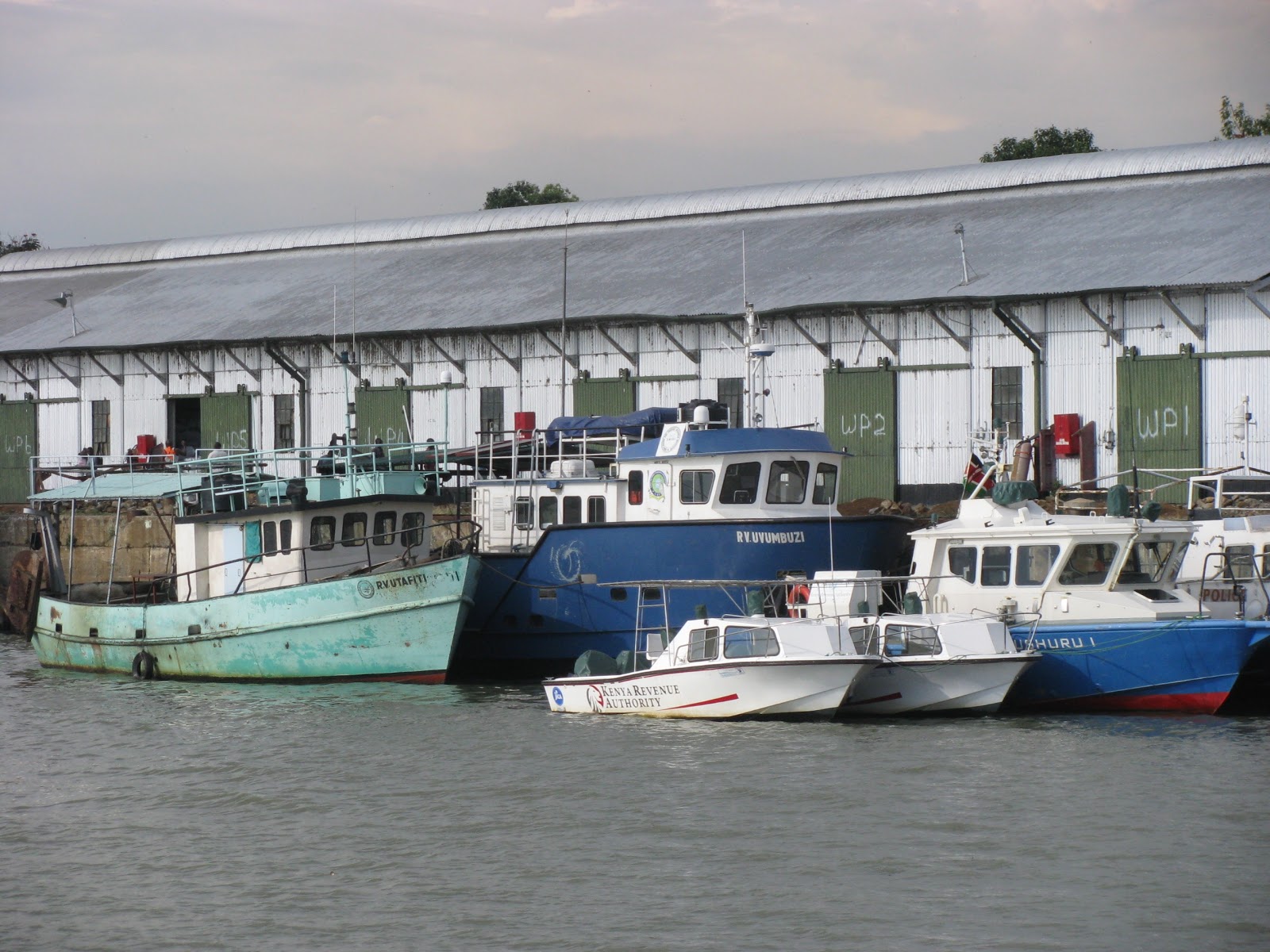
Lake Victoria is the second-largest lake in the world, in terms of surface area. In that respect, this freshwater lake is more like a Sea. The dynamics due to its dimension ensures that. It glues Uganda, Tanzania and Kenya together, in more ways than one than just geographically. Ships transporting cargo of soap, plastic and cooking oil ply from Kisumu to Mwanza-Tanzania and Jinja-Uganda. The Migingo Island in the Lake is a bone of contention between Uganda and Kenya, and often hostilities arise over its occupation and ownership. But, for the local populace on its shores, the Sea spells livelihood and life, itself.


Also read: Lake Victoria - Part II (Living by the Lakeside)
http://padmaja-earthletters.blogspot.com/2011/08/living-by-lakeside.html


Saturday, May 21, 2011

EARTH SONG


From fallow ground
raided by weeds
lying low, dormant
since eons; now
nursing a sip of dew
springs…
a sapling of viable ancestry
progeny of yesteryear

Wild dahlia, white

long buried and forgotten
prises its past
rears its head once again
simmering snowflakes or stars
kindling dreary landscape
declares…
the Womb of the Earth
is forever fertile.


Padmaja Parulkar